
Understanding Smartphone Screen Protection Technologies
Smartphones have become an important part of everyday life. We use them for communication, photography, banking, entertainment, study, work, navigation, and many other activities. Because the screen is the part of the phone that we interact with most, protecting it has become extremely important.
When I started reading about smartphone displays and screen protection technologies, I realized that protecting a smartphone screen is much more complicated than simply putting strong glass on the front of the device. Modern smartphone manufacturers use specially developed glass, chemical strengthening processes, protective coatings, ceramic materials, and carefully designed phone frames to reduce the possibility of damage.
Understanding smartphone screen protection technologies can help us make better choices when buying and using a phone. It can also explain why some phones survive accidental drops while others develop scratches or cracks.
Why Smartphone Screens Need Protection
A smartphone screen faces many risks during normal daily use. It may come into contact with keys, coins, dust, tables, bags, and other hard objects. A phone can also accidentally fall onto concrete, tiles, roads, or wooden floors.
The challenge for smartphone manufacturers is that users want several things at the same time. They want a screen that is thin, clear, responsive, attractive, scratch resistant, and strong enough to survive accidental impacts.
Ordinary glass would not provide the right balance of these qualities. This is why smartphone companies use specially developed cover glass.
Cover glass is the transparent outer layer that sits above the actual display. Its main purpose is to protect the display and touch system underneath.
The cover glass must allow light from the display to pass through clearly. It must also allow the touchscreen sensors to recognize our fingers accurately.
At the same time, it needs to resist everyday damage.
What Is Smartphone Cover Glass?
Many people simply refer to the front of a smartphone as the screen, but a modern display is made from several layers.
The visible protective surface is usually cover glass. Beneath it are layers responsible for touch detection and image production.
If the outer glass becomes scratched or cracked, the display underneath may sometimes continue working. However, severe damage can eventually affect touch response and display quality.
Modern cover glass is specially engineered to improve strength while remaining thin.
Companies such as Corning, SCHOTT, and AGC have developed different types of protective glass for electronic devices. Corning Gorilla Glass is one of the best known examples. SCHOTT produces Xensation glass, while AGC developed the Dragontrail family of protective glass.
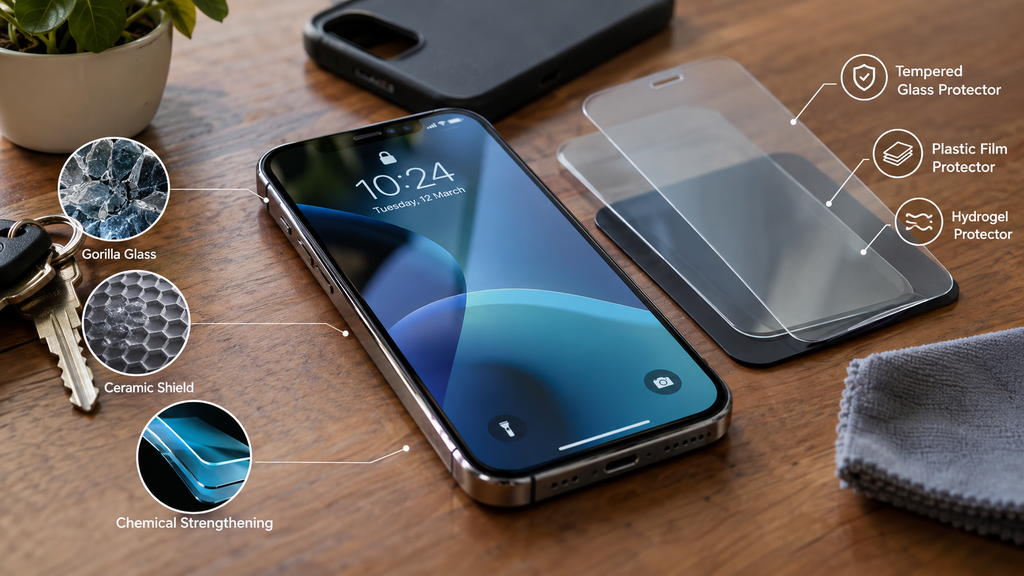
How Chemically Strengthened Glass Works
One of the most interesting things I learned while studying smartphone protection is that the strength of the glass does not depend only on its thickness.
Modern smartphone cover glass can be strengthened through a process called chemical strengthening.
During this process, the glass is treated in a controlled chemical environment. Smaller ions near the surface of the glass are replaced with larger ions.
These larger ions create compression near the surface.
This compressed surface makes it more difficult for small cracks to grow when the glass experiences pressure or impact.
This allows manufacturers to create relatively thin glass that can still provide considerable strength.
Chemical strengthening is important because simply making the glass much thicker would create other problems. A thick front panel could increase the weight of the phone, affect its appearance, and make the device less comfortable to hold.
Manufacturers therefore try to achieve the best balance between strength, thickness, weight, clarity, and touch sensitivity.
Gorilla Glass Technology
Gorilla Glass is probably the most familiar name when people talk about smartphone screen protection.
It is produced by Corning and has been used in smartphones, tablets, laptops, watches, and other electronic products.
Different generations of Gorilla Glass have focused on improving resistance to common forms of damage.
Some generations have improved drop resistance, while others have focused on improving both scratch resistance and impact performance.
For example, Corning developed Gorilla Glass Victus with improved scratch and drop performance compared with earlier materials. Gorilla Glass Victus 2 was later designed to improve performance when devices are dropped onto rough surfaces such as concrete. In Corning laboratory testing, Victus 2 survived drops of up to one meter onto a surface designed to represent concrete.
It is important to understand that laboratory tests do not guarantee that every phone will survive the same fall.
Real accidents are unpredictable.
A phone may land directly on its corner, screen, frame, or camera area. The surface may contain small stones or sharp particles. The angle of impact also changes the amount of force transferred to the glass.
This means stronger glass reduces risk, but it does not make a smartphone impossible to break.
Ceramic Shield Technology
Another important development in smartphone protection is the use of glass ceramic materials.
Apple uses a technology known as Ceramic Shield on iPhones.
Instead of relying only on conventional smartphone glass, this technology uses ceramic related material engineering to improve durability. Current Apple information describes Ceramic Shield as an important part of iPhone protection, with newer models using Ceramic Shield 2 on the front for improved scratch resistance.
The idea behind glass ceramic technology is interesting because engineers can combine useful characteristics of glass with carefully controlled ceramic structures.
The result is still designed to provide the transparency required for a smartphone display while improving durability.
However, the same rule applies here as with other protective technologies. Stronger does not mean unbreakable.
A badly positioned fall can still damage a phone.
Dragontrail Glass
Another protective material that has appeared on electronic devices is Dragontrail glass from AGC.
Dragontrail was designed as a lightweight and scratch resistant cover glass for devices such as smartphones, tablets, and notebook computers. AGC explains that the material uses chemical strengthening to improve its properties.
Dragontrail demonstrates that smartphone protection is not based on one single material or manufacturer.
Different device makers may choose different glass depending on the design, price, thickness, manufacturing requirements, and durability targets of a particular phone.
One interesting industry change is that AGC announced in December 2025 that it would exit its specialty glass business for chemical strengthening, with manufacturing of the Dragontrail series at its Takasago Factory scheduled to end during the third quarter of 2026.
This shows how smartphone technology continues to change as manufacturers and suppliers adjust their products and business strategies.
SCHOTT Xensation Glass
SCHOTT is another company involved in high performance smartphone cover glass.
Its Xensation range uses specially developed glass compositions and chemical strengthening methods.
According to SCHOTT, different Xensation versions are designed to focus on qualities such as break resistance, scratch resistance, and overall durability.
This competition between glass manufacturers is useful for smartphone development because every improvement encourages companies to create thinner and stronger devices.
However, comparing two types of glass only by their names can sometimes be misleading.
The final durability of a smartphone depends on much more than the brand of glass used.
Scratch Resistance and Drop Resistance Are Different
One of the most important ideas to understand is that scratch resistance and drop resistance are not exactly the same thing.
A material can perform well against scratches but still crack during a severe fall.
Similarly, a glass designed to absorb impact may still develop small scratches through repeated contact with hard particles.
Scratch resistance describes how well the surface resists marks caused by contact with harder materials.
Drop resistance describes how well the glass survives sudden impact.
Manufacturers try to improve both, but engineering always involves compromises.
Making glass extremely hard may help it resist scratching, but the complete structure also needs enough toughness to manage impact energy.
This is why smartphone glass technology continues to evolve.
Why Sand Can Be Dangerous for Smartphone Screens
Many people worry about keys scratching their phone screens, but tiny mineral particles can sometimes be a greater problem.
Sand and dust may contain hard mineral particles.
If these particles become trapped between a phone and another surface, pressure can cause visible marks on the glass.
This can happen inside pockets, bags, cars, or on tables.
Therefore, even a smartphone with advanced protective glass should be kept away from unnecessary contact with sand and abrasive dirt.
Cleaning the screen carefully is also important.
Instead of rubbing a dusty screen aggressively, it is better to remove loose particles first and then clean the surface gently using an appropriate soft cloth.
What Is an Oleophobic Coating?
Modern smartphone displays often have another layer of protection called an oleophobic coating.
The word oleophobic refers to resistance to oils.
Human fingers naturally contain oils, which is why fingerprints appear so easily on glass.
An oleophobic coating helps reduce the way these oils stick to the screen. It also makes fingerprints easier to wipe away.
This coating does not provide the same type of protection as strengthened cover glass.
Its main purpose is to improve the feel and cleanliness of the display.
Over time, oleophobic coatings can gradually wear down because of regular use, cleaning, friction, and exposure to certain chemicals.
This is why an older phone may feel slightly different when sliding a finger across the screen compared with when it was new.
Tempered Glass Screen Protectors
Even when a smartphone already uses strong cover glass, many people add a separate tempered glass screen protector.
This is a thin piece of strengthened glass installed on top of the original phone screen.
Its main benefit is that it provides an additional replaceable layer.
If the protector becomes heavily scratched or cracked, it can usually be removed and replaced without changing the original display.
Tempered glass protectors can be useful for people who regularly use their phones in environments where accidental damage is more likely.
They can also help preserve the appearance of a device over several years.
However, the quality of screen protectors varies.
A poorly designed protector may reduce touch sensitivity, create bubbles, affect display clarity, interfere with fingerprint sensors, or leave part of the screen uncovered.
Choosing the correct protector for the exact phone model is therefore important.
Plastic Film Protectors
Plastic film is another type of smartphone screen protection.
These protectors are usually thinner and more flexible than tempered glass.
They are mainly useful for reducing minor scratches.
Some people prefer them because they add very little thickness to the phone and can work well with curved screens.
However, plastic films generally do not provide the same impact protection people expect from thicker tempered glass.
They may also develop marks over time.
Their main advantage is simple surface protection rather than major impact resistance.
Hydrogel Screen Protectors
Hydrogel protectors have also become popular, especially for phones with curved displays.
These protectors are flexible and can cover screen shapes that are difficult for rigid glass protectors.
Some hydrogel materials can reduce the appearance of very small surface marks over time because of the flexible nature of the material.
They are also thin and usually maintain good touch sensitivity.
However, they feel different from real glass.
A person who prefers a smooth glass surface may still prefer tempered glass.
Choosing between hydrogel and tempered glass therefore depends partly on the design of the phone and personal preference.
How Smartphone Design Helps Protect the Screen
The glass itself is only one part of screen protection.
The design of the entire phone also matters.
Manufacturers carefully design the frame surrounding the display.
A slightly raised frame can reduce direct contact between the glass and a flat surface.
The shape of the corners can also influence how impact energy travels through the phone during a fall.
Phone thickness, weight, internal support, frame material, and glass bonding methods can all affect durability.
This explains why two smartphones using similar cover glass may perform differently after being dropped.
Screen durability should therefore be viewed as a complete design problem rather than simply a glass problem.
Does a Phone Case Protect the Screen?
A good phone case can significantly contribute to overall protection.
Cases with raised edges around the display can help prevent the screen from directly touching a surface when the phone falls face down.
Cases can also absorb some impact around the corners and sides.
The corners are especially important because an impact in these areas can transfer stress into the glass.
For this reason, combining a protective case with a suitable screen protector can provide an additional level of everyday protection.
No accessory can completely guarantee that a phone will survive every accident, but reducing direct impact can lower the risk of damage.
Can Strong Smartphone Glass Still Scratch?
Yes.
This is an important point because marketing terms such as tough, durable, and scratch resistant can sometimes create unrealistic expectations.
Scratch resistant does not mean scratch proof.
Any glass can eventually develop marks under the right conditions.
Small mineral particles, repeated friction, hard surfaces, and accidental contact with abrasive materials can damage even advanced smartphone glass.
The purpose of modern protective technology is to reduce the likelihood of damage during normal use.
It cannot remove the laws of physics.
Why Screen Protection Technology Keeps Improving
Smartphones have changed considerably over the years.
Screens have become larger, bezels have become smaller, and devices often contain more glass on both the front and back.
These design changes create new challenges.
A larger piece of glass has more surface area that can potentially experience an impact.
Modern phones can also be relatively heavy because they contain larger batteries, complex camera systems, wireless charging components, and powerful processors.
Corning has specifically discussed the challenge created by larger and heavier smartphones when developing newer cover glass technologies.
This is one reason why screen protection technology continues to improve.
Consumers want attractive devices without giving up durability.
How to Protect a Smartphone Screen in Daily Life
Advanced screen technology works best when combined with sensible habits.
I think one of the easiest habits is avoiding placing a phone in the same pocket as objects that can damage it.
Keeping the device away from sand and abrasive surfaces also helps.
Using a well fitted case can reduce damage during accidental falls.
A screen protector may be useful for people who want an extra replaceable layer above the original glass.
The screen should also be cleaned using suitable materials rather than rough cloth or aggressive chemicals.
Most importantly, we should remember that no smartphone display is indestructible.
Technology can reduce risk, but careful handling still matters.
What to Look for When Buying a Smartphone
When comparing smartphones, screen protection should be considered together with several other factors.
Look at the type of cover glass used, the design of the frame, water and dust resistance, availability of suitable protective cases, repair costs, and overall construction quality.
It is also useful to remember that impressive laboratory numbers should be treated as testing information rather than a promise that the device will survive every accident.
Real world conditions are much more complicated.
The angle of the fall, height, phone weight, surface material, temperature, existing scratches, and even tiny particles at the point of impact can affect the result.
Final Thoughts
After learning about smartphone screen protection technologies, I realized how much engineering is hidden inside something that looks as simple as a sheet of glass.
Modern smartphones use specially developed cover glass, chemical strengthening, ceramic materials, surface coatings, protective frames, and carefully designed structures to improve durability.
Technologies such as Gorilla Glass, Ceramic Shield, Xensation, and other strengthened cover materials show how much research goes into protecting modern displays.
At the same time, no screen technology can make a smartphone completely immune to scratches or cracks.
There will always be limits to what thin transparent materials can survive.
For everyday users, the best approach is to understand what these technologies actually do. Strong cover glass reduces the risk of damage. Protective coatings improve the way the screen feels and handles fingerprints. Screen protectors add a replaceable layer. Cases help reduce impact around the edges and corners.
When all these methods work together, a smartphone has a much better chance of remaining in good condition for a long time.
Smartphone screen protection technology will probably continue improving as phones become larger, thinner, and more advanced. For users, that means future devices may become better at surviving the small accidents that are almost impossible to avoid in everyday life.
How Smartphone Processors Affect Everyday Performance
Understanding Fast Charging on Modern Smartphones
Understanding Smartphone Refresh Rates in Simple Terms
About The Author
