How E Ink Displays Differ From Traditional Screens
When we look at modern technology, screens are one of the most important parts of our daily lives. We use screens on smartphones, tablets, laptops, televisions, smartwatches, and many other devices. Most of these screens use technologies like LCD and OLED, which are designed to provide bright colors, fast response, and smooth visuals. However, there is another type of display technology that works in a completely different way. This technology is called E Ink display.
E Ink displays have become popular because they provide a reading experience that feels closer to paper. Devices such as electronic readers use E Ink technology to allow people to read books for long periods without the same eye discomfort that can happen with traditional screens. While traditional displays focus on brightness, speed, and rich colors, E Ink displays focus on simplicity, low power consumption, and comfortable viewing.
Understanding the difference between E Ink displays and traditional screens helps us know why each technology is used for different purposes. Both have their own advantages, and the choice depends on how a person plans to use the device.
What Is an E Ink Display?
An E Ink display is a type of electronic paper technology designed to imitate the appearance of printed paper. Instead of producing light like a smartphone screen, an E Ink display reflects light from the environment, similar to how a real book page works.
The technology behind E Ink uses tiny capsules filled with black and white particles. These particles move when an electrical signal is applied. The movement of these particles creates text and images on the screen. Because the display only changes when the content changes, it uses very little power compared to traditional screens.
This design makes E Ink displays especially useful for devices where reading is the main purpose. Electronic readers, digital notebooks, and some smart devices use E Ink because it provides a comfortable reading experience.
How Traditional Screens Work
Traditional screens such as LCD and OLED displays work differently from E Ink technology. These screens create images by producing their own light.
LCD screens use a backlight behind the display panel. The light passes through liquid crystals that control how much light reaches each pixel. Different colors are created by combining red, green, and blue subpixels.
OLED screens use tiny organic light emitting diodes that produce their own light. Each pixel can turn on or off individually, which allows OLED displays to produce deep blacks and strong contrast.
These technologies are excellent for watching videos, playing games, browsing websites, and using applications that require moving images. However, because they produce light continuously, they usually consume more power than E Ink displays.
Difference in Viewing Experience
One of the biggest differences between E Ink displays and traditional screens is the way they look while being viewed.
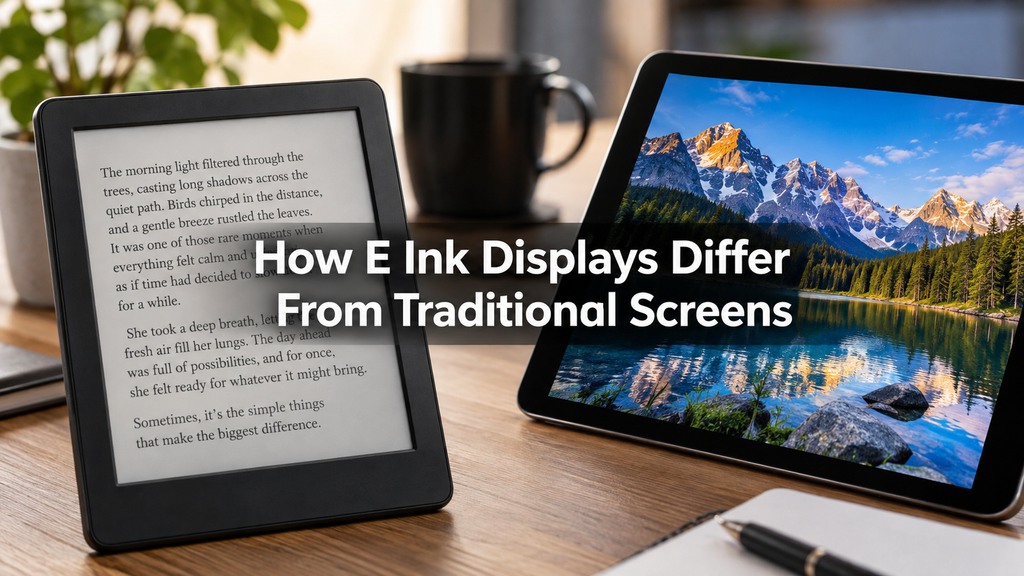
An E Ink display has a paper like appearance. Since it reflects natural light instead of creating light, it can be easier to view for long reading sessions. Many people find it comfortable because there is no strong glow coming directly from the screen.
Traditional screens create bright and colorful images. They are designed to attract attention with high contrast, smooth animations, and detailed visuals. However, long exposure to bright screens may cause discomfort for some users, especially when using devices in dark environments.
For reading novels, articles, and documents, E Ink can provide a more natural experience. For entertainment and multimedia activities, traditional screens usually provide a better experience.
Power Consumption Comparison
Battery life is another major area where E Ink displays are different from traditional screens.
E Ink technology uses power only when the screen content changes. Once text or an image appears on the display, it can remain visible without using additional energy. This allows E Ink devices to operate for weeks on a single charge in many cases.
Traditional screens require continuous power because they constantly refresh the image and produce light. Smartphones and tablets with bright displays often need daily charging, especially with heavy use.
This low power consumption makes E Ink technology useful for people who want a device mainly for reading or writing without worrying about frequent charging.
E Ink Displays and Eye Comfort
Many readers choose E Ink devices because of their comfortable viewing experience. Since E Ink screens do not shine light directly into the eyes, they can feel similar to reading a printed book.
Traditional screens can also be used safely, especially with features like dark mode, brightness control, and blue light reduction settings. However, the experience is different because these screens are still producing light.
For students, researchers, and people who spend many hours reading digital content, E Ink displays can be an attractive option. They create a calm reading environment that feels closer to traditional paper.
Color and Image Quality Differences
Traditional screens have a clear advantage when it comes to colors and image quality. Modern LCD and OLED displays can show millions of colors with high brightness and excellent detail.
This makes them perfect for watching movies, editing photos, creating digital artwork, and playing video games. The smooth movement and realistic colors make content more enjoyable.
E Ink displays have improved over time, and some newer versions support color. However, they still cannot match traditional screens in terms of brightness, color accuracy, and video performance.
The main goal of E Ink is not to replace television or smartphone displays. Instead, it focuses on providing a better experience for reading and simple digital tasks.
Speed and Refresh Rate
Another important difference is screen speed.
Traditional displays refresh very quickly. A smartphone screen can update many times per second, which creates smooth scrolling, animations, and video playback.
E Ink displays are slower because their particles need time to move into position. When turning pages or scrolling, users may notice a small delay or a brief screen refresh effect.
This slower response is not a major problem for reading books. However, it makes E Ink less suitable for activities that require fast movement, such as gaming or watching action videos.
Use of E Ink Displays in Modern Devices
E Ink technology is mainly used in electronic readers, but its applications are expanding. Many digital notebook devices now use E Ink screens because they provide a natural writing experience.
Students, professionals, and writers use E Ink tablets for taking notes, reviewing documents, and organizing information. Some smart devices also use E Ink because of its long battery life.
The technology is also being explored for smart labels, digital signs, and other low power applications. As the technology improves, more industries may find new ways to use E Ink displays.
Advantages of Traditional Screens
Traditional screens remain popular because they are extremely versatile. Smartphones, computers, and televisions need displays that can handle many different tasks.
Some major advantages of traditional screens include:
High quality colors
Fast response time
Better video performance
Higher brightness
Support for advanced graphics
Ability to display complex applications
These features make traditional screens suitable for entertainment, communication, business, and creative work.
Advantages of E Ink Displays
E Ink displays offer different benefits that make them valuable for specific users.
Some important advantages include:
Very long battery life
Paper like reading experience
Less direct light exposure
Excellent outdoor visibility
Lightweight device design
Comfortable long term reading
These advantages explain why E Ink continues to have a strong position even when smartphones and tablets are becoming more powerful.
Which Display Technology Is Better?
There is no single answer because E Ink and traditional screens are designed for different purposes.
If someone wants a device for reading books, writing notes, or studying documents, an E Ink display may provide a better experience. It offers comfort and efficiency.
If someone needs a device for watching videos, browsing social media, gaming, photography, or professional design work, a traditional display is usually more suitable.
The best choice depends on personal needs. Many people even use both technologies because each one solves a different problem.
The Future of E Ink Technology
E Ink technology continues to develop. Companies are working on improving color quality, refresh speed, and flexibility. Future E Ink displays may become more advanced while keeping their main advantages of low power use and comfortable viewing.
As people become more aware of digital health and battery efficiency, technologies like E Ink may become more important. The demand for devices that provide focused and distraction free experiences is also increasing.
E Ink is not designed to replace every traditional screen. Instead, it provides another option for people who want a different way to interact with digital content.
Conclusion
E Ink displays and traditional screens represent two different approaches to visual technology. Traditional screens focus on brightness, speed, colors, and entertainment, while E Ink displays focus on simplicity, efficiency, and a paper like reading experience.
The biggest differences can be seen in power consumption, viewing comfort, refresh speed, and image quality. E Ink displays are excellent for reading and writing, while traditional screens remain the best choice for multimedia and advanced digital tasks.
As technology continues to improve, both types of displays will continue to play an important role. Understanding their differences helps users choose the right device according to their needs and lifestyle.
What Is Edge Computing and Why Does It Matter

How Smart Home Devices Communicate With Each Other
What Digital Twins Are and How They Work
About The Author
