
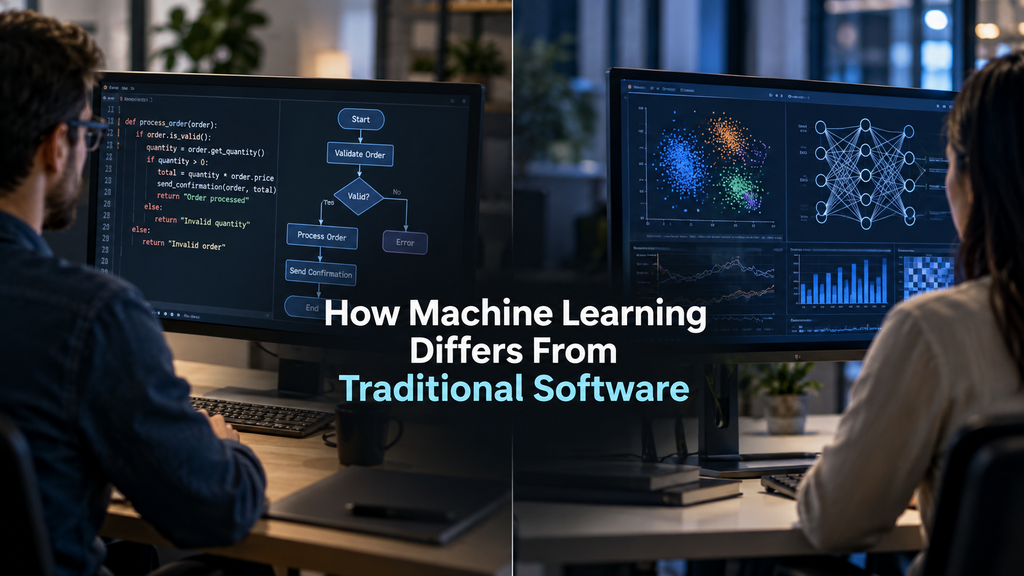
How Machine Learning Differs From Traditional Software
Technology has changed the way people solve problems, manage information, and make decisions. For many years, traditional software was the main way computers performed tasks. Developers wrote specific instructions, and computers followed those instructions exactly. Today, a new approach called machine learning has changed how computers learn and handle complex problems. Instead of depending only on fixed instructions, machine learning systems can learn from data, identify patterns, and improve their performance over time.
Understanding the difference between machine learning and traditional software helps us understand why modern technologies like recommendation systems, voice assistants, image recognition, and automated decision making have become possible. Although both approaches use computers and programming languages, the way they solve problems is completely different.
What Is Traditional Software?
Traditional software works according to predefined rules created by programmers. In this approach, developers analyze a problem, create a set of instructions, and then write code that tells the computer exactly what to do. The computer does not learn or change its behavior unless a programmer updates the software manually.
For example, consider a simple calculator application. A developer writes instructions for addition, subtraction, multiplication, and division. When a user enters numbers, the software follows those instructions and provides an answer. The software does not need previous examples because the rules are already defined.
Traditional software is based on a simple relationship:
Rules plus Data equals Results
The programmer creates the rules, and the computer applies them to the provided information. This approach works extremely well for many tasks where the problem can be clearly explained with fixed instructions.
Examples of traditional software include accounting programs, word processors, website systems, and many business applications. These programs perform tasks efficiently because their operations are predictable and controlled.
What Is Machine Learning?
Machine learning is a branch of artificial intelligence that allows computers to learn from data instead of relying only on manually written instructions. In machine learning, developers create algorithms that allow computers to discover patterns and make predictions based on previous examples.
Instead of telling a computer every single rule, programmers provide large amounts of data and allow the system to find useful relationships within that data.
The basic idea of machine learning can be explained as:
Data plus Learning Algorithm equals Model
The model created through this process can then analyze new information and make decisions based on what it has learned.
For example, instead of programming a computer with every possible rule for recognizing a cat in an image, developers provide thousands or millions of pictures of cats and other objects. The machine learning system studies these examples and learns the important features that help it identify cats in new images.
The Main Difference Between Machine Learning and Traditional Software
The biggest difference between machine learning and traditional software is how they handle instructions and information.
Traditional software depends on rules written by humans. Machine learning depends on patterns discovered from data.
In traditional programming, humans provide the intelligence through instructions. In machine learning, humans provide examples, and the system develops its own ability to make decisions.
This difference makes machine learning useful for problems where writing exact rules is difficult or impossible.
For example, detecting spam emails using traditional software would require programmers to create thousands of rules about suspicious words, email patterns, and sender behavior. However, spam detection through machine learning can analyze millions of emails and automatically learn what characteristics are common in unwanted messages.
The Role of Data in Machine Learning
Data is one of the most important parts of machine learning. Without high quality data, a machine learning model cannot learn effectively. Data acts as the experience from which the system improves.
Traditional software can work with small amounts of information because it already has defined rules. Machine learning systems often require large datasets because they learn by observing examples.
For instance, a weather application based on traditional software may display information using programmed calculations. A machine learning weather system can analyze years of weather data, identify patterns, and improve forecasting accuracy.
The quality, quantity, and variety of data directly affect the performance of a machine learning system.
Programming Approach Differences
In traditional software development, programmers focus on creating logical instructions. They think about every possible situation and write code to handle those situations.
In machine learning development, programmers focus on designing models, selecting suitable algorithms, and preparing data. They do not manually create every decision rule. Instead, they create an environment where the computer can discover useful patterns.
This changes the role of developers. A traditional software developer spends more time writing direct instructions, while a machine learning engineer spends more time collecting data, training models, testing results, and improving accuracy.
Learning Ability and Adaptation
Another important difference is the ability to improve automatically.
Traditional software does not learn from experience. If a business wants to add a new feature or improve performance, developers usually need to modify the code.
Machine learning systems can improve through additional training. When new data becomes available, the model can learn from that information and become more accurate.
For example, a music recommendation system learns from user behavior. If millions of users listen to certain songs, skip others, or create playlists, the system can identify preferences and provide better recommendations.
This ability to adapt is one reason machine learning has become important in modern technology.
Handling Complex Problems
Traditional software is excellent for problems with clear rules. However, many real world problems are complicated because they involve uncertainty, changing conditions, and large amounts of information.
Machine learning is designed to handle these types of challenges.
Examples include:
Image recognition
Language translation
Medical diagnosis assistance
Fraud detection
Self driving vehicle technology
Voice recognition
Customer behavior analysis
These tasks require understanding patterns rather than following simple instructions.
For example, recognizing a person’s face in a photograph involves analyzing thousands of small details. Creating fixed rules for every possible face, lighting condition, and angle would be extremely difficult. Machine learning solves this problem by learning from many examples.
Accuracy and Errors
Both traditional software and machine learning systems can produce errors, but the reasons are different.
Traditional software errors usually happen because of incorrect programming, missing rules, or technical problems. Since the instructions are fixed, developers can often identify and correct the issue directly.
Machine learning errors often happen because of poor data, limited training examples, or incorrect assumptions learned by the model. Improving the system may require better data or changing the learning process.
This means machine learning requires continuous monitoring and improvement.
Examples of Machine Learning in Daily Life
Many people use machine learning technology every day without realizing it.
Search engines use machine learning to understand user queries and provide relevant results. Streaming platforms analyze viewing habits to suggest movies and shows. Online shopping websites recommend products based on customer behavior.
Smartphone features also use machine learning. Face recognition, voice assistants, camera improvements, and battery optimization systems often depend on machine learning models.
Email services use machine learning to identify spam messages and improve security. Social media platforms use it to organize content and understand user interests.
These examples show that machine learning is becoming a normal part of modern digital life.
Advantages of Traditional Software
Traditional software still has many advantages. It is predictable, easier to understand, and often simpler to maintain. When rules are clear, traditional programming can provide reliable results.
For example, banking calculations, payroll systems, and inventory management often work well with traditional software because their processes follow specific rules.
Traditional systems are also easier to test because developers know exactly how the software should behave.
Advantages of Machine Learning
Machine learning provides benefits that traditional software cannot easily achieve.
It can analyze huge amounts of data quickly, discover hidden patterns, and improve over time. It is especially valuable when problems involve uncertainty or require predictions.
Businesses use machine learning to understand customers, improve services, reduce costs, and make better decisions.
Researchers use machine learning to analyze scientific information and discover new possibilities in areas such as healthcare and environmental studies.
The Future of Software Development
The future of technology will likely include both traditional software and machine learning working together. Traditional programming remains important because many tasks require clear rules and precise operations.
Machine learning will continue to expand because modern society produces enormous amounts of data that can be analyzed for useful insights.
Developers of the future will need to understand both approaches. Knowing when to use traditional software and when to use machine learning will become an important skill in technology.
Conclusion
Machine learning and traditional software represent two different ways of solving problems with computers. Traditional software depends on rules created by programmers, while machine learning allows computers to learn from data and improve through experience.
Traditional software remains valuable for predictable tasks with clear instructions. Machine learning becomes powerful when dealing with complex problems where patterns are difficult to define manually.
The main difference is not that one technology replaces the other. Instead, they serve different purposes. Traditional software provides control and reliability, while machine learning provides adaptability and the ability to discover new solutions.
As technology continues to develop, understanding the difference between machine learning and traditional software will help people better understand how modern digital systems work and how artificial intelligence is shaping the future.

Understanding AI Chatbots and Their Common Uses

Understanding RAM and Its Role in Computer Performance

What Automation Software Can Do for Everyday Tasks
About The Author
