
How Smartphone Processors Affect Everyday Performance
Smartphones have become a major part of everyday life. We use them for communication, photography, entertainment, online shopping, banking, navigation, studying, and work. While many people compare phones by looking at the camera, display, battery size, or storage, one of the most important parts of a smartphone often receives less attention. That part is the smartphone processor.
The processor plays a central role in how quickly and smoothly a phone performs daily tasks. It affects how fast apps open, how smoothly games run, how well the camera processes photos, how efficiently the battery is used, and even how long a phone continues to feel fast after several years.
Understanding how smartphone processors affect everyday performance can make it easier to choose a phone that matches your needs. You do not need to understand complicated engineering details. A basic understanding of processors is enough to explain why one phone feels fast and responsive while another may feel slow even when both appear similar on paper.
What Is a Smartphone Processor?
A smartphone processor is a small electronic component that performs calculations and helps control many of the phone’s operations. It receives instructions from apps and the operating system and then processes those instructions.
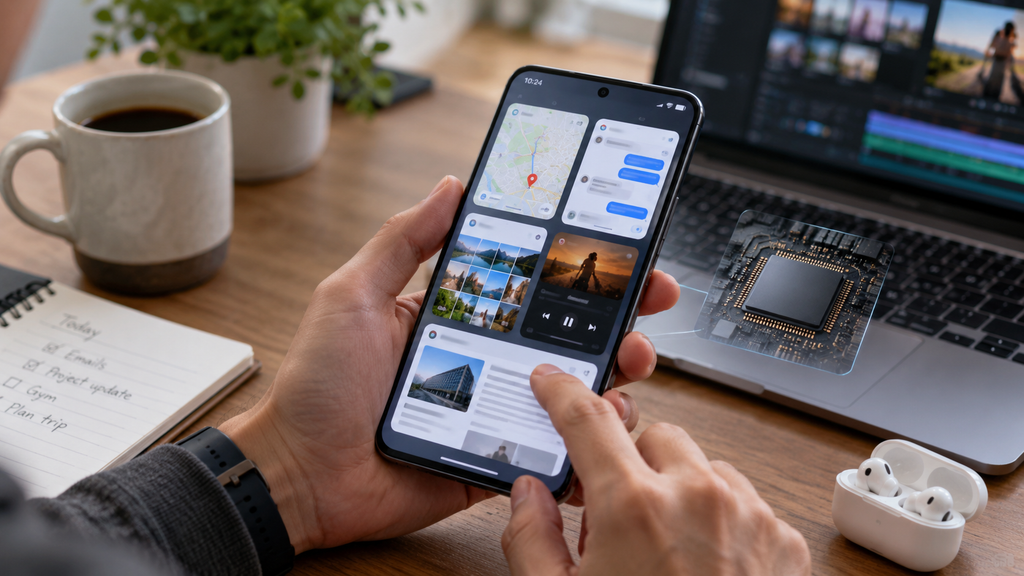
Modern smartphone processors are usually part of a larger system known as a System on Chip, often shortened to SoC.
A System on Chip combines several important components into one small chip. These may include the central processing unit, graphics processor, image processor, artificial intelligence engine, modem, and other controllers.
Because so many functions are combined into a single chip, the processor has a major influence on the overall performance and efficiency of the smartphone.
Whenever you open an app, take a picture, browse a website, play a video, or send a message, the processor is working in the background.
The Role of the CPU in Everyday Smartphone Performance
The CPU, or central processing unit, handles many of the basic instructions required by the phone.
When you tap an app icon, the CPU helps load that application. When you type a message, browse the internet, calculate something, or move through phone menus, the CPU processes those actions.
Most modern smartphone CPUs contain several processing cores. These cores allow the processor to handle different tasks efficiently.
Some cores are designed for demanding tasks that require high performance. Other cores are designed for lighter activities and use less power.
For example, reading a text message does not require the same amount of processing power as editing a high resolution video. A well designed processor can select the right cores for each task.
This balance helps a smartphone remain responsive without unnecessarily draining the battery.
Faster Processors Help Apps Open Quickly
One of the easiest ways to notice processor performance is by opening applications.
A powerful smartphone processor can load apps quickly because it is able to process instructions at a faster rate. This becomes especially noticeable when using larger applications such as social media platforms, games, photo editors, navigation apps, and productivity software.
A slower processor may still open the same applications, but the process can take longer.
For example, you may tap an app and wait several seconds before the main screen appears. With a faster processor, the same app may become available almost immediately.
The difference of a few seconds may not seem important at first. However, people open and switch between applications many times throughout the day.
Over time, these small delays can significantly affect how smooth the phone feels.
Processor Performance Affects Multitasking
Modern smartphones are designed to perform several tasks at once.
You may be listening to music while browsing the internet. You may switch between a messaging app, email, maps, and a banking application. Some people also use split screen features that allow two apps to remain visible at the same time.
The processor plays an important role in managing this activity.
A stronger processor can handle multiple tasks without becoming overloaded easily. However, processor power is only one part of multitasking performance. The amount of RAM inside the phone is also important.
RAM stores temporary information for apps that are currently being used. The processor works together with RAM to manage applications efficiently.
A phone with a good processor and enough RAM usually feels smoother when switching between apps.
If either component is limited, applications may reload frequently or become slow during heavy multitasking.
Smartphone Processors Have Different Types of Cores
Many modern smartphone processors use a combination of powerful and efficient cores.
High performance cores are designed to complete demanding tasks quickly. Efficiency cores are designed to handle simpler activities while using less electricity.
This design helps the phone balance speed with battery life.
Imagine that you are reading a simple webpage. The phone does not need to use its most powerful cores continuously. Smaller efficiency cores can handle much of this work.
If you launch a demanding game or start editing video, the processor can activate its more powerful cores.
This flexible approach allows modern smartphones to provide strong performance while controlling energy use.
The quality of this balance can make a large difference in everyday experience.
Processors Affect Gaming Performance
Gaming is one of the most demanding activities for a smartphone.
Mobile games may require the phone to calculate physics, animations, artificial intelligence, sound, and many visual effects at the same time.
The processor helps manage these calculations.
However, graphics performance is mainly handled by another part of the processor called the GPU, or graphics processing unit.
The GPU is responsible for producing the images that appear on the screen.
A powerful GPU can display detailed graphics while maintaining a smooth frame rate. A weaker GPU may require the game to use lower visual settings.
When playing demanding games, a stronger smartphone processor may provide smoother movement, quicker loading, and more stable performance.
The cooling system of the phone is also important because heat can reduce processor speed during long gaming sessions.
How Processors Affect Smartphone Cameras
Many people assume that the camera sensor alone determines smartphone photo quality. In reality, the processor also plays a major role.
Modern smartphone cameras depend heavily on computational photography.
When you press the camera button, the phone may perform many calculations before the final image appears.
The processor may adjust exposure, combine multiple images, reduce noise, improve colors, sharpen details, identify faces, and create background blur.
An important part of this process is performed by the image signal processor.
A more advanced processor may allow a phone to process photographs faster and apply more complicated image techniques.
This is one reason two phones using similar camera hardware can still produce different results.
The software and processor can influence image quality almost as much as the physical camera components.
Artificial Intelligence Features Depend on Processing Power
Artificial intelligence features have become common in smartphones.
Phones can recognize objects in pictures, improve voice recognition, translate languages, organize photographs, enhance camera settings, and perform many other intelligent functions.
Some processors include special components designed specifically for artificial intelligence calculations.
These components may be called neural processing units or AI engines.
By performing these calculations directly on the device, the smartphone can sometimes complete AI tasks faster and with better privacy because information may not always need to be sent to an online server.
As smartphones continue to include more AI features, processor capability is becoming increasingly important.
Processor Efficiency Affects Battery Life
A faster processor does not always mean shorter battery life.
Modern processors are designed to complete tasks efficiently.
If a powerful processor can complete an operation quickly, it may return to a low power state sooner. A slower and less efficient processor may need to work longer to complete the same task.
The manufacturing technology used to create the chip also influences energy efficiency.
Newer processors are often produced using smaller manufacturing processes. These designs may improve performance while reducing electricity consumption.
However, battery life depends on many other factors as well.
Display brightness, network connection, battery capacity, software optimization, background apps, and screen refresh rate can all affect how long a phone lasts between charges.
The processor is therefore an important part of battery performance, but it is not the only factor.
Heat Can Affect Smartphone Processor Speed
Processors produce heat when they work hard.
During demanding activities such as gaming, video recording, navigation, or video editing, the processor may generate a noticeable amount of heat.
Smartphones cannot use large cooling fans like desktop computers. Manufacturers must rely on compact cooling systems built inside the phone.
If the processor becomes too hot, the phone may automatically reduce its speed.
This process is often called thermal throttling.
Thermal throttling protects the device from excessive heat, but it can temporarily reduce performance.
For example, a smartphone may provide excellent gaming performance during the first ten minutes. After the device becomes hot, the frame rate may become lower.
For this reason, processor performance should not be judged only by short benchmark tests. Sustained performance can be equally important.
The Processor Influences Video Recording
Recording high quality video requires considerable processing power.
Modern smartphones can record high resolution video at high frame rates. Some devices also support advanced stabilization, dynamic range processing, background effects, and other features.
The processor must handle large amounts of data from the camera sensor in real time.
A more capable processor may support higher resolutions, smoother frame rates, and better image processing.
It may also reduce the time required to save or edit the recorded footage.
People who regularly create videos for social media, work, or personal projects should therefore pay attention to processor performance.
Web Browsing Depends on Processor Performance
Websites have become more complicated over the years.
Modern websites may contain video, animation, interactive menus, advertisements, maps, and many scripts running at the same time.
The processor helps the browser handle this information.
A stronger processor can make websites load and respond more quickly.
Scrolling may feel smoother, buttons may respond faster, and complicated pages may open with less delay.
Internet speed remains important, but a fast internet connection cannot completely compensate for weak processing hardware.
The phone still needs enough processing power to display and manage the content it receives.
Social Media Apps Also Use Significant Processing Power
Social media applications may appear simple, but many are surprisingly demanding.
They constantly load images, videos, comments, animations, advertisements, notifications, and personalized content.
Some apps also use camera filters and video effects that require significant processing power.
A capable smartphone processor can make social media feeds feel smoother and more responsive.
Uploading and editing videos can also become faster.
This is particularly useful for people who frequently create short videos, edit photos, or manage social media accounts from their phones.
Processors Affect Software Updates and Long Term Performance
A smartphone may perform well when it is new, but its processor can also influence how well it performs several years later.
Operating systems and applications gradually become more advanced. New software may require additional processing power.
A phone with a stronger processor usually has more performance available for future software requirements.
This does not guarantee that the phone will remain fast forever, but it can help extend its useful life.
Software support from the manufacturer is equally important.
A powerful processor is less valuable if the phone stops receiving security updates or operating system improvements.
For long term use, processor performance and software support should be considered together.
Why Benchmark Scores Do Not Tell the Whole Story
Benchmark applications are commonly used to compare smartphone processors.
These tests measure different types of performance and produce numerical scores.
Benchmark results can be useful when comparing devices, but they should not be treated as the only measurement of smartphone quality.
A phone may achieve an excellent benchmark score but become hot during extended use.
Another phone may have a slightly lower score while maintaining more stable performance over a longer period.
Software optimization also matters.
A well optimized phone can sometimes feel smoother in everyday use even when its processor is not the fastest available.
Benchmarks are therefore useful for understanding general performance levels, but real world experience should also be considered.
The Operating System Works Closely With the Processor
Hardware alone does not determine smartphone performance.
The operating system controls how processor resources are used.
Good software optimization can help the processor complete tasks efficiently.
Poor optimization can make even powerful hardware feel slower than expected.
Smartphone manufacturers often adjust their software to match specific processors.
These adjustments can affect animations, battery management, gaming performance, background activity, and application loading.
This is why two phones containing similar processors may still provide different everyday experiences.
Processor Performance Matters for Navigation
Navigation apps constantly perform calculations while you travel.
They use GPS data, maps, traffic information, and location calculations to determine routes.
The processor helps update your position and redraw the map as you move.
A capable processor can make navigation feel more responsive, especially when switching routes, zooming into maps, or moving between apps.
The modem inside or connected to the processor also affects network performance.
Modern smartphone chips may support advanced mobile networks and faster data connections.
This can help navigation apps receive updated traffic information more quickly when network coverage is available.
Video Streaming Relies on Efficient Processing
Watching video is one of the most common smartphone activities.
The processor contains specialized hardware that can decode video efficiently.
This allows smartphones to play high resolution content without using excessive battery power.
A modern processor may support newer video formats and higher resolutions.
Efficient video decoding is especially important because streaming videos can run continuously for long periods.
If the processor had to use its main CPU cores for every part of video playback, battery consumption could increase significantly.
Specialized video hardware helps reduce this workload.
Everyday Users Do Not Always Need the Fastest Processor
The most powerful smartphone processor is not necessary for everyone.
Many everyday activities such as messaging, calling, reading email, browsing simple websites, watching videos, and using social media can run well on a midrange processor.
People who mostly perform basic tasks may notice little difference between a high end phone and a good midrange model during normal use.
The difference becomes more noticeable during demanding tasks.
Heavy gaming, advanced photography, video editing, large productivity apps, and intensive multitasking can benefit greatly from stronger processors.
Choosing the right phone therefore depends on how you plan to use it.
Entry Level Processors
Entry level processors are designed for affordable smartphones.
They usually provide enough performance for basic communication, browsing, video playback, and social media use.
However, they may become slower when running demanding applications or switching between many apps.
Camera processing may also take longer.
For people who mainly need a phone for simple daily tasks, an entry level processor can still provide good value.
Expectations simply need to match the capabilities of the device.
Midrange Processors
Midrange smartphone processors have improved greatly.
Many now provide enough power for smooth everyday use, gaming, photography, streaming, and multitasking.
For the average user, this category often provides a good balance between price, performance, and battery efficiency.
A well designed midrange phone may remain responsive for several years.
This makes midrange processors attractive to people who want reliable performance without paying for premium hardware.
High End Processors
High end processors are designed for maximum smartphone performance.
They are commonly found in premium devices.
These processors usually include powerful CPU cores, advanced graphics hardware, faster AI processing, improved camera capabilities, and modern network features.
High end processors are useful for demanding mobile games, professional photography, high resolution video, editing, advanced multitasking, and other intensive activities.
They can also provide additional performance for future software updates.
However, users who mainly perform simple tasks may not fully use this extra power.
Storage Speed Also Affects Everyday Performance
Although the processor is important, smartphone speed depends on several components working together.
Storage technology affects how quickly apps and files can be loaded.
A powerful processor combined with slow storage may still experience delays.
Fast storage allows applications, games, photos, and system files to be accessed quickly.
RAM, processor speed, storage performance, software optimization, and cooling all contribute to the final user experience.
This is why judging a phone by processor name alone can sometimes be misleading.
How to Choose the Right Smartphone Processor
When choosing a phone, begin by considering your typical activities.
If you mainly use messaging apps, browse websites, make calls, and watch videos, a modern entry level or midrange processor may be sufficient.
If you regularly play demanding games, edit videos, take large numbers of photos, or keep many apps open, a stronger processor may provide a better experience.
It is also useful to check reviews that discuss real world performance.
Look for information about battery life, heat, gaming stability, software optimization, and long term performance.
A processor should be considered as part of the complete smartphone rather than as an isolated specification.
Final Thoughts
Smartphone processors have a major influence on everyday performance. They affect how quickly applications open, how smoothly the interface responds, how well games run, how photographs are processed, and how efficiently the phone uses battery power.
A processor also influences multitasking, video recording, web browsing, artificial intelligence features, navigation, and long term usability.
However, processor performance is only one part of the overall smartphone experience. RAM, storage speed, cooling, software optimization, battery capacity, and display technology also matter.
The best smartphone processor is not necessarily the fastest processor available. It is the processor that provides enough performance for your daily needs while maintaining good efficiency and reliability.
Understanding this basic principle makes smartphone shopping much easier. Instead of focusing only on technical names or benchmark numbers, you can think about how the processor will affect the tasks you actually perform every day.
For most people, a balanced smartphone with a capable processor, sufficient memory, good software, and efficient battery management will provide a better long term experience than a device chosen only because it has impressive specifications.
Smartphone processors may remain hidden inside the device, but their impact can be felt almost every time the screen is touched. From opening a simple message to recording high quality video, the processor quietly helps turn thousands of electronic instructions into the smooth smartphone experience people expect every day.

Practical Ways to Keep a Smartphone Running Smoothly

Understanding Smartphone Screen Protection Technologies

How Mobile Operating Systems Manage Background Apps
About The Author
