
Understanding Fast Charging on Modern Smartphones
Fast charging has become one of the most useful features in modern smartphones. A few years ago, charging a phone from a low battery level to a usable level could take a long time. Today, many smartphones can gain several hours of battery life after only a short charging session.
This change has made fast charging an important part of everyday smartphone use.
People now use their phones for communication, photography, navigation, entertainment, online payments, work, and education. Because smartphones are used throughout the day, users do not always have enough time to leave them connected to a charger for several hours. Fast charging helps solve this problem by delivering more electrical power to the battery during certain stages of the charging process.
However, fast charging is more complicated than simply using a powerful charger. The smartphone, battery, charging adapter, cable, charging protocol, temperature, and software all work together to control how quickly and safely the battery receives energy.
Understanding fast charging on modern smartphones can help users choose the right charger, protect battery health, and understand why charging speed changes during different parts of the charging cycle.
What Is Fast Charging?
Fast charging is a technology that allows a smartphone battery to receive electrical energy at a higher rate than traditional charging systems.
Older smartphone chargers commonly supplied relatively low amounts of power. Modern fast chargers can deliver much higher power when connected to a compatible device.
Charging power is normally measured in watts.
Watts are calculated by multiplying voltage by current.
For example, a charger providing 5 volts at 2 amps delivers about 10 watts of power.
A fast charging system may use higher voltage, higher current, or a carefully controlled combination of both.
Modern smartphones may support charging levels such as 18 watts, 25 watts, 33 watts, 45 watts, 65 watts, 80 watts, 100 watts, or even higher depending on the device and charging technology.
However, the number printed on a charger does not mean the phone will continuously receive that amount of power.
Charging speed changes throughout the charging process.
How Smartphone Charging Actually Works
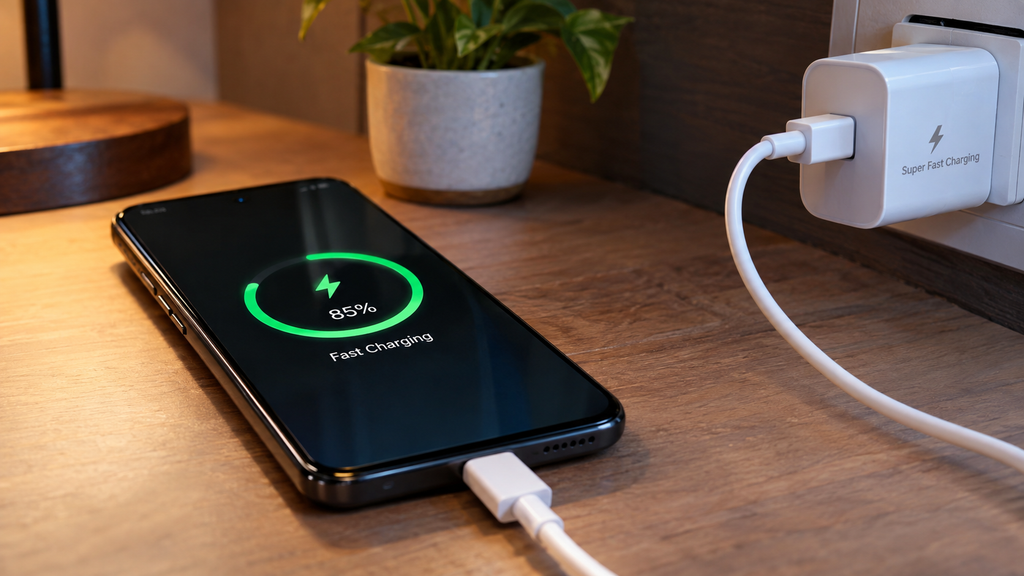
When a smartphone is connected to a charger, electricity flows from the wall outlet through the charging adapter.
The adapter converts electrical power into a form that the smartphone can safely use.
Electricity then travels through the charging cable into the phone.
Inside the smartphone, charging circuits manage the flow of electricity before energy reaches the battery.
The battery management system constantly checks several conditions.
These include battery temperature, battery voltage, charging current, battery percentage, charger capability, and overall system safety.
The phone decides how much power it can safely accept.
This means the charger does not simply force electricity into the smartphone.
Instead, the charger and phone communicate with each other and determine an appropriate charging level.
Why Fast Charging Is Faster at Low Battery Levels
One important characteristic of smartphone fast charging is that maximum charging speed usually happens when the battery is relatively low.
For example, a phone may charge very quickly from 10 percent to 50 percent.
After reaching a higher battery level, charging speed usually begins to decrease.
This happens because lithium ion batteries require more careful charging as they approach full capacity.
During the early charging stage, the battery can normally accept more current.
As the battery voltage rises, the charging system gradually reduces the amount of current.
This process protects the battery and helps prevent excessive heat or electrical stress.
For this reason, charging from 20 percent to 50 percent may feel extremely fast, while charging from 90 percent to 100 percent may take much longer.
This is normal behavior.
Why Charging Slows Near 100 Percent
Many users wonder why their phone charges quickly at first but slows down significantly near the end.
The main reason is battery protection.
Lithium ion batteries become more sensitive when they approach their maximum voltage.
Charging them too aggressively at high battery levels could increase heat and accelerate battery degradation.
Smartphones therefore use different charging stages.
During the faster stage, the phone may receive relatively high charging power.
As the battery becomes fuller, the charging system gradually reduces the current.
Near full capacity, the charging rate may become much slower.
This final stage helps the battery safely reach its maximum charge level.
The exact charging pattern varies between smartphone manufacturers and battery designs.
The Meaning of Charging Watts
Charging speed is commonly advertised using watts.
A watt measures electrical power.
If a smartphone supports 45 watt charging, it means the charging system may be designed to receive up to approximately that power level under suitable conditions.
However, maximum advertised charging power is usually reached only during certain parts of the charging cycle.
A phone supporting 45 watt charging may not receive 45 watts continuously.
Its actual charging power may rise and fall depending on battery percentage and temperature.
The phone may also reduce charging power when the screen is active or when demanding applications are running.
Therefore, wattage is useful for comparing charging systems, but it should not be treated as a guarantee of constant charging speed.
The Importance of Charging Protocols
Fast charging requires communication between the charger and smartphone.
This communication is handled through charging protocols.
A charging protocol is essentially a set of rules that allows devices to negotiate voltage and current levels.
Different manufacturers may use different technologies.
USB Power Delivery is one of the most widely used standards.
It is commonly known as USB PD.
USB Power Delivery allows compatible devices and chargers to communicate and select suitable charging levels.
Another important technology is Programmable Power Supply, commonly known as PPS.
PPS allows the charger to adjust voltage and current in smaller steps based on the phone’s needs.
Some smartphone manufacturers also use proprietary fast charging systems.
These systems may provide very high charging speeds but often require the company’s own charger and compatible cable.
This is why two chargers with the same wattage may not charge the same phone at the same speed.
Compatibility matters.
The Role of the Charging Cable
The charging cable is another important part of fast charging.
Many people focus only on the charger, but the cable also determines how much electrical power can safely pass between the charger and phone.
A cable designed for basic charging may not support very high current or power levels.
Some high power charging systems require special cables.
USB C cables can also have different electrical capabilities even when they look almost identical.
Certain cables contain electronic identification chips that help chargers and devices determine supported power levels.
Using an unsuitable cable may reduce charging speed.
In some situations, poor quality cables can also create unnecessary heat.
For reliable fast charging, the charger, cable, and smartphone should all support compatible charging specifications.
Why Temperature Matters
Heat is one of the most important factors affecting smartphone charging speed.
Lithium ion batteries perform best within a suitable temperature range.
If the phone becomes too warm, the battery management system may reduce charging power.
This process is called thermal management.
It protects the battery and internal components from excessive temperature.
Several things can increase temperature while charging.
Gaming while charging can create significant heat.
Recording video can also increase processor activity.
Navigation applications, video calls, high screen brightness, and downloading large files may also raise device temperature.
Warm environments can make the problem worse.
For example, charging a phone inside a hot car may cause the device to reduce charging speed dramatically.
Fast charging usually works best when the smartphone is cool and performing only light tasks.
Does Using the Phone Slow Charging?
Yes, using a smartphone while charging can reduce the effective charging speed.
The charger provides power to the device, but some of that power may be used immediately by the screen, processor, wireless connection, and applications.
The remaining power is available for charging the battery.
If the phone is being used heavily, less energy may reach the battery.
Heavy use also creates additional heat.
When temperature rises, the charging system may lower power to protect the device.
For this reason, leaving the screen off during charging can sometimes improve charging performance.
You do not need to stop using your phone completely, but demanding tasks may increase the total charging time.
Fast Charging and Battery Health
One of the most common questions about fast charging is whether it damages smartphone batteries.
Modern fast charging systems are designed with multiple safety controls.
The smartphone monitors voltage, current, temperature, and battery condition during charging.
Charging speed is automatically reduced when necessary.
However, all lithium ion batteries gradually lose capacity as they age.
Heat and long periods spent at very high charge levels can contribute to battery aging.
Fast charging may create more heat under certain conditions, which is why thermal management is so important.
Manufacturers design charging systems to keep temperatures within acceptable limits.
For most users, using the official or properly certified fast charger is generally part of normal smartphone operation.
Users who want to reduce long term battery stress can also avoid unnecessary heat and avoid keeping the phone at 100 percent for extremely long periods whenever practical.
What Is Optimized Charging?
Many modern smartphones include battery protection or optimized charging features.
These features study charging patterns or control charging behavior to reduce the amount of time the battery stays completely full.
For example, a phone may charge normally to around 80 percent during the night and then delay the final portion of charging.
It may complete charging closer to the time the user normally disconnects the device.
Some phones also offer manual charging limits.
A user may be able to limit maximum charging to 80 percent or another selected level.
These features are mainly designed to reduce long term battery stress.
They can be useful for people who keep their smartphones for several years.
Why Some Phones Charge Faster Than Others
Charging speed depends on much more than battery capacity.
Two smartphones with similar battery sizes may have very different charging times.
One reason is supported charging power.
A phone supporting 80 watt charging can potentially charge faster than a phone limited to 25 watts.
Battery design also matters.
Some smartphones use divided battery structures that allow charging systems to distribute power efficiently.
Thermal design is another major factor.
A smartphone with good heat management may maintain higher charging power for longer periods.
Software charging algorithms also affect performance.
Manufacturers carefully control when the phone can use maximum charging power and when power should be reduced.
This means charging speed depends on the entire charging system rather than a single specification.
Battery Capacity and Charging Time
Battery capacity is usually measured in milliamp hours.
A smartphone with a 5000 mAh battery stores more energy than a smaller battery under similar conditions.
Larger batteries may require more energy to fully charge.
However, this does not automatically mean they take longer to charge.
A large battery paired with a powerful fast charging system may charge faster than a smaller battery using a low power charger.
This is why battery capacity and charging wattage should be considered together.
Charging efficiency and battery architecture also influence total charging time.
Why Charging Speed Changes Every Day
You may notice that your phone sometimes charges quickly and sometimes charges more slowly.
Several factors can cause this.
Battery percentage is one factor.
A nearly empty battery may charge faster than one that is already above 80 percent.
Temperature is another factor.
A warm phone may reduce charging power.
Background applications may also consume energy.
The charger and cable can affect performance as well.
Even environmental conditions can make a difference.
A phone charging in a cool room may maintain higher charging power for longer than a phone charging in direct sunlight.
Charging speed should therefore be viewed as a dynamic process.
Wireless Fast Charging
Fast charging is not limited to wired connections.
Many modern smartphones support wireless charging.
Wireless charging uses electromagnetic induction to transfer energy between a charging pad and the phone.
Some devices also support faster wireless charging systems.
However, wireless charging usually produces more energy loss than wired charging.
Part of the energy can be converted into heat during wireless power transfer.
Because heat affects battery charging, thermal management is especially important for fast wireless charging.
Proper alignment between the phone and charging coil is also important.
Poor alignment may reduce efficiency and increase heat.
For maximum charging speed, wired charging is often more efficient.
Wireless charging remains popular because of its convenience.
Can a High Wattage Charger Damage a Phone?
A properly designed charger normally does not force its maximum power into every connected device.
If a charger supports 100 watts and the smartphone supports only 25 watts, the phone should request only the power level it can safely use, assuming both devices follow compatible standards.
This allows powerful USB C chargers to work with many different devices.
However, quality matters.
Poorly designed or uncertified chargers may not provide the same level of electrical protection as reputable products.
Charging equipment should include protections against problems such as overvoltage, overheating, excessive current, and electrical short circuits.
Using reliable chargers and cables is therefore important.
Can Fast Charging Be Turned Off?
Some smartphones allow users to disable fast charging through battery settings.
Others automatically control charging speed without providing a manual switch.
Turning off fast charging may be useful when charging speed is not important.
For example, someone charging their phone overnight may not need maximum charging performance.
However, modern smartphones already reduce charging power automatically when needed.
Whether disabling fast charging provides a meaningful battery health advantage depends on the device, temperature conditions, and charging habits.
Keeping the phone cool is often more important than worrying about charging speed alone.
Common Fast Charging Mistakes
One common mistake is assuming that any powerful charger will provide maximum charging speed.
The phone and charger must support compatible charging standards.
Another mistake is ignoring the cable.
A charger may support high wattage, but the cable may limit power.
People also sometimes expect maximum charging speed from zero to 100 percent.
Fast charging does not normally work that way.
Charging slows as the battery becomes fuller.
Using demanding applications while charging can also reduce charging performance.
Another common mistake is charging the phone in hot conditions.
Heat can significantly reduce charging speed.
How to Get Better Fast Charging Performance
For better charging performance, use a charger that supports the charging standard recommended for your smartphone.
Use a good quality cable capable of carrying the required power.
Keep the phone in a reasonably cool environment.
Avoid demanding tasks during short fast charging sessions when possible.
If the phone feels unusually hot, allow it to cool.
Some thick protective cases may trap heat, although removing the case is usually necessary only when overheating becomes noticeable.
Keeping the charging port clean can also help maintain a reliable connection.
Dust or debris inside the charging port can interfere with the cable connection.
Fast Charging Is About More Than Speed
The best fast charging system is not simply the one with the highest wattage number.
A good charging system balances speed, battery protection, temperature control, efficiency, and convenience.
A smartphone that briefly reaches extremely high charging power but quickly becomes hot may not provide a better real world experience than a phone with slightly lower but more stable charging performance.
Charging technology should therefore be evaluated as a complete system.
Battery size, charger design, thermal management, cable quality, and software all contribute to the final result.
The Future of Smartphone Fast Charging
Smartphone charging technology continues to improve.
Manufacturers are developing better battery materials, more efficient charging circuits, smarter temperature management, and advanced charging algorithms.
Future smartphones may offer faster charging while producing less heat.
Battery management systems are also becoming more intelligent.
Software can increasingly adjust charging behavior according to temperature, battery condition, daily routines, and expected device usage.
Wireless charging efficiency is also improving.
The long term goal is not simply to increase charging wattage.
The goal is to deliver useful charging speed while maintaining safety, efficiency, and battery durability.
Final Thoughts
Understanding fast charging on modern smartphones becomes easier when you realize that charging is a controlled process rather than a simple transfer of electricity.
The charger provides electrical power, but the smartphone decides how much power the battery can safely receive.
Charging speed changes according to battery percentage, temperature, charger compatibility, cable capability, and device activity.
Fast charging is usually most powerful when the battery is low. As the battery approaches full capacity, charging slows to protect the battery.
This is why a smartphone may gain a large amount of charge during the first part of a charging session but require much longer to complete the final few percent.
For everyday users, the most practical approach is simple. Use reliable charging equipment, keep the phone reasonably cool, use compatible cables, and allow the smartphone’s battery management system to control the charging process.
Fast charging has made modern smartphones much more convenient. Instead of waiting several hours for usable battery life, many users can connect their phones for a short period and continue with their day.
As battery technology and charging systems continue to improve, smartphone charging will likely become faster, smarter, and more efficient while placing greater emphasis on long term battery health.
How Smartphone Storage Technology Has Changed Over Time
How Mobile Operating Systems Manage Background Apps
Understanding Smartphone Screen Protection Technologies
About The Author
