
How Smartphone Storage Technology Has Changed Over Time
Smartphone storage is something most people use every day without thinking much about it. We take photos, record videos, download apps, save documents, install games, and store years of personal information on a device that fits inside a pocket. Today, even an affordable smartphone can offer more storage than many computers had only a few years ago.
What makes this change interesting is that smartphone storage has not only increased in size. It has also become faster, smaller, more reliable, and more energy efficient. The technology behind smartphone storage has gone through several important stages, from very limited built in memory to advanced flash storage capable of transferring large amounts of data in seconds.
Understanding how smartphone storage technology has changed over time helps explain why modern phones feel faster, why apps open more quickly, and why high resolution photography and video recording have become practical.
The Early Days of Mobile Phone Storage
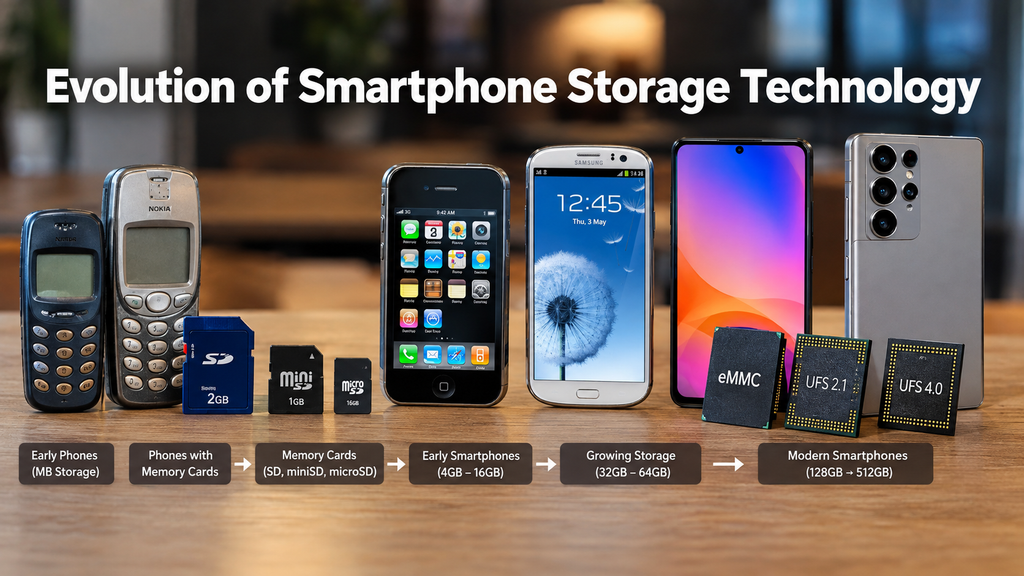
Early mobile phones were very different from the smartphones we use today. Their main purpose was calling and sending text messages. Because they did not need to store large apps, videos, or high resolution photos, their storage requirements were extremely small.
Many early phones had only a few megabytes of internal storage. This was enough for contacts, text messages, simple ringtones, and a limited number of pictures.
At that time, storage capacity was not an important selling point. People were more interested in battery life, signal strength, call quality, and the physical size of the phone.
As mobile phones began adding cameras, music players, and downloadable applications, the need for more storage quickly increased.
The Arrival of Memory Cards
One of the first major changes in mobile storage was the widespread use of removable memory cards.
Memory cards allowed users to expand the storage of their phones without replacing the device. Different formats appeared over the years, including SD cards, miniSD cards, microSD cards, and several manufacturer specific formats.
MicroSD eventually became the most common option because of its small physical size.
For many users, memory cards were extremely useful. A phone might include only a small amount of internal storage, but a memory card could provide additional space for music, pictures, videos, and files.
This was especially important when built in storage was expensive.
Instead of purchasing a more expensive phone with higher internal capacity, users could often buy a relatively inexpensive memory card.
The Growth of Built In Flash Storage
As smartphones became more advanced, manufacturers started increasing built in storage capacity.
Flash memory became the main storage technology used in smartphones because it had several advantages over traditional computer hard drives.
Flash memory has no moving mechanical parts. This makes it more suitable for portable devices that may be dropped, shaken, or carried around every day.
It is also physically small and consumes relatively little power.
These characteristics made flash memory an ideal choice for smartphones.
Early smartphones commonly offered storage capacities such as 4 GB, 8 GB, or 16 GB. At the time, these numbers seemed generous compared with older mobile phones.
However, smartphone applications and media files became larger very quickly.
Why Smartphone Storage Requirements Increased
Several changes increased the amount of storage people needed.
Smartphone cameras became much better. Higher resolution photographs required larger files.
Video recording also improved from standard definition to HD, Full HD, 4K, and eventually even higher resolutions on some devices.
Applications became more complicated as well.
A simple mobile app might require only a few megabytes, while a modern game can require several gigabytes after installation.
Operating systems also became larger because they included more features, security systems, graphics, services, and built in applications.
Because of these changes, storage capacities that once seemed large soon became insufficient.
From 16 GB to 64 GB and Beyond
For several years, 16 GB was a common storage option for smartphones.
However, users often discovered that the actual usable storage was much lower because the operating system and preinstalled software occupied part of the space.
As cameras, apps, and media files became larger, smartphone manufacturers gradually moved toward higher capacities.
32 GB became common, followed by 64 GB and 128 GB.
Today, many smartphones begin with 128 GB or more, while premium models may offer 256 GB, 512 GB, or even 1 TB of internal storage.
This increase has changed how people use their phones.
Many users can now keep thousands of photos, large video collections, games, documents, and offline entertainment without constantly deleting files.
The Difference Between Capacity and Speed
Storage capacity is only one part of smartphone storage technology.
Speed is equally important.
Two smartphones may both have 128 GB of storage, but their real world performance can be very different depending on the type of storage technology used.
Storage speed affects how quickly apps install, open, and load data.
It can also influence photography, video recording, software updates, file transfers, and overall system responsiveness.
As smartphones became more powerful, manufacturers needed faster storage to prevent it from becoming a performance bottleneck.
What Is eMMC Storage?
For many years, a technology known as eMMC was widely used in smartphones.
eMMC stands for embedded MultiMediaCard.
It combines flash memory and a controller into a compact package that can be built directly into a device.
eMMC was popular because it was affordable, reliable, and relatively simple to manufacture.
Different generations of eMMC gradually improved performance.
For basic tasks such as messaging, web browsing, and simple applications, eMMC storage worked well.
However, smartphone processors became much faster, and applications started requiring more data.
Eventually, eMMC became too slow for high performance devices.
The Move to UFS Storage
One of the most important developments in modern smartphone storage was the introduction of UFS.
UFS stands for Universal Flash Storage.
It was designed to provide significantly faster performance than older eMMC technology.
One major technical improvement is the ability to handle reading and writing more efficiently.
Modern UFS storage can process multiple operations at the same time more effectively than older storage systems.
This helps phones feel faster during everyday tasks.
For example, opening a large application, installing software, moving files, and recording high quality video can all benefit from faster storage.
UFS 2.0 and Early Improvements
UFS 2.0 was one of the versions that helped bring high speed storage to premium smartphones.
Compared with older eMMC storage, UFS offered much faster data transfer performance.
This difference became noticeable as smartphones started using more powerful processors and larger applications.
With faster storage, applications could load data more quickly.
Photo galleries containing thousands of images could open faster, and large games could reduce loading times.
Storage performance started becoming an important part of the overall smartphone experience.
The Development of UFS 2.1 and UFS 3.0
UFS technology continued to improve.
UFS 2.1 offered better performance and reliability, and it became common in many high end smartphones.
Later, UFS 3.0 provided another large improvement.
Smartphones using UFS 3.0 could achieve much faster sequential reading and writing speeds compared with earlier generations.
This was particularly helpful for large files.
For example, transferring a high resolution video or loading a large mobile game could become noticeably faster.
Faster storage also supported improvements in smartphone cameras.
Recording high bitrate video requires storage that can continuously accept large amounts of data.
UFS 3.1 and Everyday Smartphone Performance
UFS 3.1 improved efficiency and performance further.
It introduced features designed to improve writing speed, power management, and storage responsiveness.
For users, these technical improvements usually appear in simple ways.
Apps open quickly.
Large files move faster.
System updates install more efficiently.
The phone remains responsive even when several storage intensive tasks are happening.
This is an important point because smartphone performance is not determined only by the processor or RAM.
Storage performance also plays a major role.
The Arrival of UFS 4.0
UFS 4.0 represents another major step in smartphone storage technology.
It provides considerably higher potential data transfer speeds while also improving power efficiency.
This is especially useful in premium smartphones that use powerful processors, advanced cameras, and demanding applications.
Modern phones can capture extremely detailed photographs, record high resolution videos, run console style games, and perform artificial intelligence related processing directly on the device.
All of these activities can involve large amounts of data.
Faster storage helps the entire system handle this information more efficiently.
How NAND Flash Technology Has Changed
Behind technologies such as eMMC and UFS is NAND flash memory.
NAND flash stores information electronically and does not require power to keep saved data.
This makes it ideal for smartphones.
Over time, manufacturers found ways to store more information inside each memory cell.
Different types of NAND include SLC, MLC, TLC, and QLC.
These technologies differ in how many bits of information can be stored in each cell.
Storing more bits per cell allows manufacturers to increase capacity while controlling manufacturing costs.
However, there can be tradeoffs involving performance, endurance, and complexity.
Modern storage controllers use advanced techniques to manage these challenges.
The Importance of Storage Controllers
A smartphone storage system contains more than just memory chips.
The storage controller plays an important role in managing how data is written, read, organized, and maintained.
Modern controllers use sophisticated techniques to improve performance and reliability.
For example, they can distribute data across memory cells to reduce unnecessary wear.
They can also manage errors and maintain performance over time.
These features are mostly invisible to users, but they help smartphone storage remain dependable during years of daily use.
Why Some Smartphones Removed Memory Card Slots
Expandable storage was once very common, but many modern premium smartphones no longer include microSD card slots.
There are several reasons for this change.
Built in storage is usually faster than many removable memory cards.
Using fixed internal storage also gives manufacturers more control over performance and reliability.
Removing the card slot can also simplify internal design and help with water resistance.
However, expandable storage still offers important advantages.
A microSD card can provide inexpensive additional space, especially for photos, videos, music, and downloaded media.
For this reason, some smartphone manufacturers continue to support memory cards in certain models.
Cloud Storage Changed the Meaning of Phone Storage
Another major development has been the growth of cloud storage.
Services that back up photos, documents, messages, and other files have changed the way people think about local smartphone storage.
In the past, almost everything had to remain physically stored on the phone or memory card.
Today, some information can be kept online and downloaded when needed.
Cloud services can also automatically back up important files.
This provides protection if a phone is lost, damaged, or replaced.
However, cloud storage does not completely replace internal storage.
Applications still need local space, and large photos or videos may need to remain on the device when internet access is limited.
Smartphone Cameras Have Driven Storage Innovation
Camera technology has been one of the biggest reasons smartphone storage has grown so rapidly.
Early phone cameras produced very small image files.
Modern smartphones can capture high resolution images with advanced processing, RAW photography, HDR information, and multiple camera data streams.
Video files can be even larger.
Recording several minutes of 4K video can consume a significant amount of storage.
Some smartphones also support professional video formats that create very large files.
Without faster and larger storage systems, many modern camera features would be difficult to use effectively.
Gaming Has Also Increased Storage Demand
Mobile gaming has changed dramatically.
Older mobile games were often extremely small.
Modern games can include detailed three dimensional graphics, high quality sound, large maps, downloadable updates, and cinematic scenes.
Some major mobile games may require tens of gigabytes after all resources are installed.
As mobile processors have become more powerful, smartphones have started handling games that once required dedicated gaming systems.
This has made storage capacity and speed increasingly important for gamers.
Storage and Smartphone Artificial Intelligence
Artificial intelligence features are also beginning to influence smartphone storage requirements.
Some modern phones store AI models directly on the device.
These models may support features such as image processing, voice recognition, translation, text generation, photo editing, and intelligent search.
Keeping AI models locally can improve privacy and allow certain features to work without continuous internet access.
However, advanced AI models may require significant storage.
As on device AI continues developing, storage technology will likely become even more important.
Why Free Storage Space Matters
Even with modern storage technology, keeping some free space available is useful.
Smartphones often use free storage for temporary files, application caches, software updates, and system operations.
When storage becomes almost completely full, some phones may feel slower or have difficulty installing updates.
This does not mean users need to keep half of their storage empty.
However, leaving reasonable free space can help the operating system manage files more efficiently.
Regularly reviewing unnecessary downloads, duplicate photos, and unused applications can help maintain available storage.
How Storage Technology Affects Battery Life
Storage technology also affects power consumption.
Every time a phone reads or writes data, the storage system uses energy.
More efficient storage can perform tasks quickly while reducing power usage.
This may not create a dramatic difference during simple activities, but efficiency becomes more important during heavy tasks such as video recording, gaming, or transferring large files.
Newer storage standards are designed not only for speed but also for better energy efficiency.
This is important because smartphone manufacturers are constantly balancing performance with battery life.
Smartphone Storage Has Become More Reliable
Reliability has improved significantly over time.
Modern flash storage includes advanced error correction and wear management systems.
These technologies help maintain stored data and extend the useful life of memory cells.
Smartphones also use software systems that monitor and manage storage automatically.
For most users, this means the storage system works quietly in the background without requiring attention.
Although any electronic storage device can eventually fail, modern smartphone storage is generally designed to handle years of normal use.
What the Future of Smartphone Storage May Look Like
Smartphone storage will probably continue becoming faster and more efficient.
Storage capacity is also likely to increase as cameras, games, AI tools, and applications become more demanding.
Higher capacity phones may become increasingly common, while advanced storage standards will continue improving transfer speeds.
Future smartphones may also use more intelligent systems to manage the balance between local and cloud storage.
For example, frequently used files might remain on the device while older files are automatically moved to cloud storage.
AI could also help identify unnecessary files and optimize storage usage.
Choosing Smartphone Storage Today
When choosing a smartphone, it is useful to consider both storage capacity and storage technology.
A user who mostly makes calls, browses the internet, and uses basic social apps may not need extremely large storage.
Someone who records a lot of video, plays large games, or keeps many files offline may benefit from 256 GB or more.
It is also worth checking whether the phone supports expandable storage.
For performance focused users, the storage standard can matter as well.
A modern UFS based phone can offer a noticeably smoother experience than a device using much slower storage, especially during demanding activities.
Conclusion
The history of smartphone storage technology reflects the wider development of smartphones themselves.
Early mobile phones needed only a small amount of memory for contacts and messages. As phones gained cameras, music players, apps, games, and internet access, storage capacity had to grow rapidly.
Removable memory cards helped users expand their devices, while built in flash storage gradually became larger and faster.
The transition from technologies such as eMMC to advanced UFS storage greatly improved smartphone performance.
At the same time, NAND flash technology, storage controllers, cloud services, and improved software management made modern storage more reliable and efficient.
Today, smartphone storage is not simply a place where files are saved. It is an important part of overall performance.
Fast storage helps applications open quickly, cameras record high quality video, games load smoothly, and operating systems respond efficiently.
As smartphones continue becoming more powerful, storage technology will continue evolving with them.
The difference between the tiny memory found in early mobile phones and the hundreds of gigabytes available in modern smartphones shows just how quickly mobile technology has progressed.
For everyday users, these improvements mean something very simple: more space, faster performance, and fewer limitations when using a smartphone.
SEO Information
Primary Keyword: Smartphone Storage Technology
Secondary Keywords: smartphone storage evolution, mobile phone storage, UFS storage, eMMC storage, smartphone internal storage, flash memory in smartphones, smartphone storage capacity
SEO Title: How Smartphone Storage Technology Has Changed Over Time
Meta Description: Learn how smartphone storage technology has evolved from small internal memory and microSD cards to fast UFS storage, large capacities, cloud storage, and modern flash memory.
Suggested URL Slug: smartphone-storage-technology-changed-over-time

What Is eSIM and How Does It Work on Mobile Devices?

Understanding Smartphone Screen Protection Technologies

Understanding Smartphone Refresh Rates in Simple Terms
About The Author
