
What Is eSIM and How Does It Work on Mobile Devices?
Smartphones have changed a lot over the years. Displays have become sharper, cameras have improved, batteries have become more efficient, and mobile networks have become much faster. Along with these visible changes, some important changes have also happened inside the phone. One of them is the introduction of eSIM technology.
For many years, mobile phones depended on a small physical SIM card. Whenever someone bought a new mobile connection, changed a network, or moved to another phone, they normally had to remove the SIM card and insert it into another device.
eSIM changes this process.
Instead of using a removable plastic card, eSIM technology allows a mobile network profile to be stored digitally inside the phone. This can make switching networks, activating a new mobile plan, and managing multiple numbers much easier.
When I first started reading about eSIM technology, I thought it was simply a digital version of a normal SIM card. That explanation is partly correct, but there is much more happening behind the scenes.
In this article, I will explain what eSIM is, how eSIM works on mobile devices, how it compares with a physical SIM, and what advantages and limitations users should understand before using it.
What Is eSIM?
The term eSIM means Embedded Subscriber Identity Module.
A traditional SIM card is a removable chip that you insert into a smartphone. An eSIM performs a similar job, but the important difference is that the eSIM hardware is already built into the device.
You do not normally remove it.
Instead of receiving a physical card from a mobile network operator, you can download a network profile to your phone.
This profile contains information that allows the mobile network to identify your subscription and connect your device to its services.
In simple terms, a physical SIM carries your network identity on a removable card, while an eSIM stores that identity electronically on a built in component.
Why Do Mobile Phones Need a SIM?
To understand eSIM properly, it helps to understand the purpose of a SIM.
A SIM helps a mobile network identify a subscriber.
When your phone connects to a mobile network, the network needs to know whether your subscription is valid and what services you are allowed to use.
These services may include calling, text messaging, mobile data, roaming, and other features provided by your operator.
The SIM contains important subscriber information that helps with this authentication process.
Without a valid SIM or eSIM profile, a normal smartphone usually cannot access standard cellular services from a mobile operator.
This is why eSIM does not remove the need for subscriber identification. It simply changes the way that information is stored and managed.
How Does eSIM Work?
An eSIM compatible device contains a secure electronic component that can store mobile network profiles.
When you purchase an eSIM plan from a supported mobile operator, the operator gives you a method for downloading the required profile.
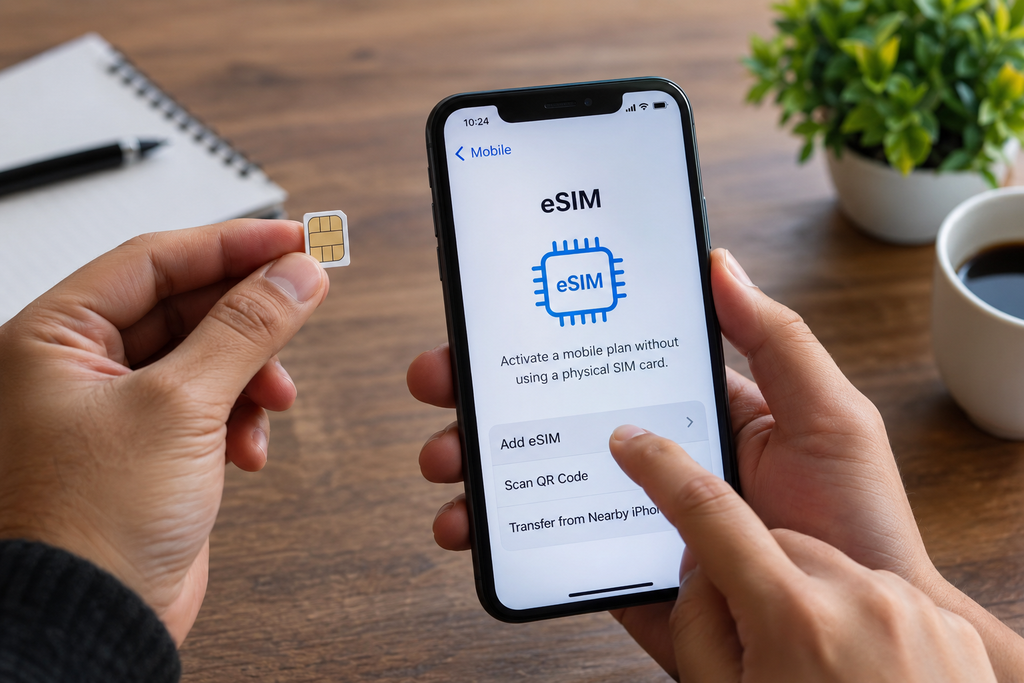
Many operators provide a QR code.
You open the mobile network settings on your phone, choose the option to add an eSIM or mobile plan, and scan the QR code.
The phone then contacts the appropriate activation system and downloads the operator profile.
After activation is completed, the phone can use that profile to connect to the mobile network.
The exact steps can vary depending on the smartphone manufacturer, operating system, and mobile operator.
Some operators may allow activation through their mobile app instead of a QR code.
Others may automatically transfer an eSIM when a user moves from one supported phone to another.
The important point is that the subscriber profile is delivered digitally rather than through a removable card.
What Happens During eSIM Activation?
Although eSIM activation may look simple to the user, several things happen in the background.
First, the mobile operator creates or assigns a cellular subscription.
The operator then provides activation information to the customer.
When the customer enters that information or scans the QR code, the smartphone securely communicates with systems responsible for delivering the eSIM profile.
The profile is downloaded to the secure eSIM component inside the device.
Once installed, the mobile network can authenticate the subscription and allow the phone to connect.
From the user’s point of view, the process may only take a few minutes when everything is properly supported.
Is eSIM the Same as a Physical SIM?
The main purpose is similar, but the format is different.
A physical SIM is a removable object.
An eSIM is built into the phone.
With a physical SIM, changing networks may involve replacing the card.
With eSIM, changing networks may involve downloading a different network profile.
Both methods allow mobile operators to identify subscribers and provide cellular services.
The biggest difference is therefore not the basic purpose of the SIM. It is how the subscriber information is delivered, stored, and managed.
Can a Phone Have Both eSIM and Physical SIM?
Yes. Many modern smartphones support both.
A device may contain one physical SIM slot together with eSIM capability.
This can be useful for people who want to use two mobile numbers on one phone.
For example, one number may be used for personal calls while another is used for work.
Another user may keep a physical SIM from a local network while adding an eSIM for international travel.
However, the number of active SIMs that can be used at the same time depends on the device.
Some phones can store several eSIM profiles but may only allow a limited number to remain active simultaneously.
What Is Dual SIM With eSIM?
Dual SIM allows a phone to use two cellular subscriptions.
In older phones, dual SIM usually meant that the phone contained two physical SIM slots.
With eSIM technology, manufacturers can provide dual SIM support in different ways.
A phone might use one physical SIM and one eSIM.
Some models may support two active eSIM profiles.
This can be convenient because users can keep separate numbers without carrying two smartphones.
For example, someone can use one line for family communication and another line for business.
The phone can usually allow users to select which SIM should handle calls, text messages, and mobile data.
Can Multiple eSIM Profiles Be Stored?
Many eSIM compatible devices can store more than one eSIM profile.
This does not necessarily mean that all profiles can remain active at the same time.
You might store profiles from several mobile operators and activate the one you need.
This feature can be especially useful for frequent travelers.
Imagine someone who travels regularly between three countries. Instead of keeping several physical SIM cards in a wallet, the traveler may be able to store different eSIM profiles on the phone.
When arriving in another country, the appropriate profile can be activated if the device and carrier support it.
How Is eSIM Useful for International Travel?
Travel is one of the situations where eSIM can be particularly convenient.
Traditionally, international travelers often had to buy a physical SIM card after arriving in another country.
That could mean finding a mobile shop, showing identification where required, buying a SIM, opening the phone’s SIM tray, and storing the original SIM somewhere safe.
With eSIM, a traveler may be able to purchase a compatible mobile data plan online before arriving.
The profile can then be added digitally.
This can make it easier to access mobile data shortly after reaching the destination.
However, travelers should always check network coverage, phone compatibility, pricing, data limits, and local regulations before purchasing a travel eSIM.
Does eSIM Improve Mobile Internet Speed?
Not automatically.
An eSIM does not make mobile internet faster simply because it is digital.
Network speed mainly depends on factors such as mobile coverage, network technology, signal strength, network congestion, phone hardware, and the mobile plan being used.
A physical SIM and an eSIM connected to the same network under similar conditions should not have a major performance difference just because of the SIM format.
Therefore, users should not choose eSIM expecting it to increase internet speed.
Its major benefits are related to convenience and flexibility.
Is eSIM More Secure?
eSIM can provide some useful security advantages.
A physical SIM can be removed from a lost or stolen phone.
An eSIM cannot normally be taken out in the same simple way because it is built into the device.
This may make it more difficult for someone to physically remove the SIM immediately.
However, eSIM does not eliminate security risks.
Mobile accounts can still be targeted through social engineering, account takeover attempts, phishing, weak passwords, or fraudulent SIM transfer requests.
Users should still protect their mobile accounts carefully.
Strong account passwords, device screen locks, two factor authentication, and secure carrier account settings remain important.
What Happens If an eSIM Phone Is Lost?
If a phone containing an eSIM is lost, the user should contact the mobile operator as soon as possible.
The operator may be able to suspend the line or help transfer the subscription to another device.
Users should also use built in device security features such as remote tracking and remote locking when available.
The exact recovery process depends on the mobile operator and smartphone platform.
This is one reason it is useful to understand the recovery procedure before an emergency happens.
Can eSIM Be Transferred to Another Phone?
In many cases, yes, but the process is not always identical.
Some smartphone systems support direct eSIM transfer between compatible devices.
In other cases, the old eSIM may need to be removed and the mobile operator may provide a new activation code.
Certain carriers require customers to use an app, website, customer service process, or store visit.
Because carrier policies differ, users should check the transfer procedure before switching phones.
This is especially important when replacing a phone unexpectedly.
Advantages of eSIM Technology
One of the biggest benefits of eSIM is convenience.
There is no tiny card to handle or lose.
Network activation can often be completed digitally.
Users may also be able to store multiple mobile plans on one device.
Travelers can add compatible international plans without physically replacing their main SIM.
eSIM can also help smartphone manufacturers save some internal space because a traditional SIM tray may not always be required.
The saved space may be small, but smartphone design often depends on using every available area efficiently.
Removing physical openings can also simplify certain parts of device design.
Possible Disadvantages of eSIM
eSIM also has some limitations.
The first problem is compatibility.
Not every smartphone supports eSIM.
Even when a phone supports the technology, not every mobile operator provides eSIM service.
Another limitation appears when switching phones.
With a physical SIM, moving a number can sometimes be as simple as removing the card and placing it in another compatible device.
An eSIM transfer may require additional activation steps.
People who regularly move one SIM between multiple phones may therefore find a physical SIM more convenient in some situations.
There can also be problems when a phone is damaged and cannot be turned on.
Users may need help from their operator to activate the same number on another device.
Does Every Smartphone Support eSIM?
No.
eSIM support depends on the phone model, region, network operator, and sometimes the specific version of the device.
Some smartphones sold in one market may support eSIM while a similar version sold elsewhere may use different SIM configurations.
Before buying an eSIM plan, users should check the specifications of their exact smartphone model.
They should also confirm that the phone is unlocked if they plan to use an eSIM from a different network provider.
How Can You Check If Your Phone Supports eSIM?
The easiest method is to check the official specifications of your phone.
You can also open the network or SIM settings.
Look for options such as Add eSIM, Add Mobile Plan, Add Cellular Plan, or similar wording.
The exact menu names vary between Android phones and iPhones.
Another option is to contact your mobile operator and provide the exact smartphone model.
This is often helpful because a phone may support eSIM technically but may not be supported by a particular network.
What Is an eSIM QR Code?
An eSIM QR code contains information that helps your phone locate and download the correct mobile network profile.
It is not simply an image representing your phone number.
When scanned through the proper eSIM setup menu, it helps start the activation process.
Because this information may be linked to your mobile subscription, it should be treated carefully.
Users should avoid publicly sharing activation QR codes.
If a QR code has already been used, its reuse depends on the rules of the mobile operator.
Some codes can only be used once.
How Do You Install an eSIM?
The general installation process is simple.
First, confirm that your phone supports eSIM.
Next, purchase or request an eSIM plan from a supported mobile operator.
Open the mobile network settings on your smartphone.
Choose the option for adding an eSIM or cellular plan.
Scan the QR code provided by the operator or follow the app based setup process.
Allow the phone to download and install the profile.
After installation, select how you want to use the new line.
For example, you may choose it for mobile data, phone calls, or both.
The wording and exact steps may differ between devices.
Does eSIM Use More Battery?
Normally, using eSIM instead of a physical SIM does not create a major battery difference by itself.
However, battery consumption can increase when two mobile lines remain active because the phone may need to maintain connections with more than one network.
Network conditions also matter.
A phone working with weak cellular signals may consume more power while trying to maintain a connection.
Therefore, battery life depends more on network usage and signal conditions than on whether the subscription uses eSIM or a physical SIM.
Is eSIM Good for Everyday Users?
For many people, yes.
Someone who uses the same network for years may not notice a huge difference between eSIM and physical SIM.
However, people who travel frequently, use multiple numbers, or regularly change mobile plans may find eSIM particularly convenient.
It reduces the need to handle small SIM cards and allows more parts of mobile service management to happen digitally.
The best option still depends on the user’s needs and the quality of local carrier support.
What Is the Future of eSIM?
eSIM is gradually becoming more common across smartphones, tablets, smartwatches, and other connected devices.
The technology fits naturally with the wider move toward digital services.
Instead of visiting a store to receive a physical card, customers can potentially activate mobile service remotely.
This can make cellular connectivity easier for many types of devices.
Wearable devices are a good example.
A smartwatch has very limited internal space, so using an embedded SIM can be more practical than designing a removable SIM tray.
Connected cars, tablets, laptops, and Internet of Things devices can also benefit from embedded cellular technology.
eSIM vs Physical SIM
Choosing between eSIM and physical SIM is not simply about deciding which technology is better.
Both have advantages.
A physical SIM is familiar, removable, and easy to move between many compatible phones.
An eSIM is digital, difficult to physically lose, and convenient for managing multiple plans.
For travelers and users with several mobile subscriptions, eSIM can provide significant flexibility.
For people who frequently move a SIM between old and new phones, a physical SIM may still feel simpler.
Many smartphones currently support both approaches, allowing users to choose whichever method fits their situation.
Final Thoughts
eSIM is one of those smartphone technologies that can sound complicated until the basic idea is understood.
The concept is actually simple.
A traditional SIM stores subscriber information on a removable card. An eSIM stores mobile network profiles on a secure component built into the device.
This allows users to activate compatible mobile plans digitally without inserting a physical SIM card.
The technology can make switching networks, managing multiple numbers, and using international mobile plans more convenient.
At the same time, eSIM does not automatically provide faster mobile data or better network coverage. Those factors still depend mainly on the mobile operator, network technology, signal strength, and phone hardware.
Compatibility is also important because not every phone and network supports eSIM in the same way.
As more smartphones and connected devices adopt the technology, eSIM is likely to become an increasingly normal part of mobile connectivity.
For everyday users, the most important thing is not whether a SIM is physical or embedded. What matters is having a reliable mobile connection that is easy to activate, secure to use, and suitable for personal needs.
Understanding how eSIM works makes it easier to decide whether this technology is useful when buying a new smartphone, changing mobile networks, or preparing for international travel.
Understanding Smartphone Refresh Rates in Simple Terms

What Makes a Smartphone Camera Useful in Everyday Photography
Why Some Smartphones Receive Software Updates for Longer
About The Author
