
What Is Edge AI and Where Is It Being Used?
Introduction
Artificial Intelligence has changed the way people use technology in everyday life. From voice assistants on smartphones to smart cameras and automated systems in industries, AI is becoming part of many digital experiences. However, traditional artificial intelligence systems usually depend on cloud servers where data is sent, processed, and then returned to the user. This method works well in many situations, but it also creates challenges related to speed, privacy, and internet dependency.
This is where Edge AI becomes important. Edge AI is a technology that brings artificial intelligence processing closer to the place where data is created. Instead of sending all information to distant cloud servers, Edge AI allows devices such as smartphones, cameras, vehicles, and machines to analyze data locally. This makes AI systems faster, more efficient, and more reliable.
In simple words, Edge AI means using artificial intelligence directly on devices at the edge of a network. The edge refers to the location where data is generated, such as a mobile phone, security camera, factory machine, or smart sensor. By combining AI algorithms with edge computing, devices can make decisions without always depending on the internet.
Understanding Edge AI
To understand Edge AI better, it is important to understand the difference between cloud based AI and edge based AI. In a traditional AI system, a device collects data and sends it through the internet to a powerful cloud server. The server processes the information using advanced AI models and sends the result back to the device.
For example, when you use an online voice assistant, your voice recording may travel to a cloud server where it is analyzed before a response is generated. This process can take time because the data must travel between different locations.
Edge AI changes this process by allowing AI models to run directly on the device. A smartphone, camera, or machine can analyze information locally and provide immediate results. This reduces delays and allows devices to work even when internet connectivity is weak or unavailable.
Edge AI combines two major technologies: artificial intelligence and edge computing. Artificial intelligence provides the ability to learn, recognize patterns, and make decisions. Edge computing provides the ability to process information closer to the source of data.
Together, these technologies create smarter and faster devices.
How Does Edge AI Work?
Edge AI works by placing trained AI models inside devices. First, an AI model is created using large amounts of data. During the training process, the model learns how to identify patterns and make predictions.
After training, the AI model is optimized and installed on an edge device. The device can then use the model to analyze new information without sending everything to the cloud.
For example, a smart security camera with Edge AI can identify movement, recognize objects, and detect unusual activity directly on the camera itself. It does not need to send every video frame to a remote server. This saves bandwidth and allows faster responses.
Modern Edge AI devices use specialized hardware such as AI chips, neural processing units, and advanced processors. These components are designed to handle artificial intelligence tasks efficiently while using less power.
Benefits of Edge AI
One of the biggest advantages of Edge AI is speed. Since data does not need to travel to a cloud server and back, devices can respond almost instantly. This is extremely important in situations where quick decisions are required.
For example, self driving vehicles need to analyze road conditions, pedestrians, and traffic signals within milliseconds. Waiting for cloud processing could create safety risks. Edge AI allows vehicles to process important information locally.
Another important benefit is improved privacy. Many people are concerned about sending personal information to online servers. Edge AI reduces this concern because sensitive data can be processed directly on the device.
For example, a smartphone using facial recognition can identify a user without uploading facial data to the internet. This provides better control over personal information.
Edge AI also reduces internet dependency. Devices can continue working even when there is limited connectivity. This is useful in remote areas, industrial locations, and emergency situations.
Another advantage is reduced network costs. Since less data needs to be transferred to cloud servers, companies can save bandwidth and reduce operational expenses.
Edge AI in Smartphones
Smartphones are one of the most common places where Edge AI is being used. Modern smartphones contain powerful processors that can perform AI tasks directly on the device.
Many smartphone features depend on Edge AI. Camera improvements, facial recognition, voice commands, translation tools, and battery optimization all use artificial intelligence.
For example, smartphone cameras use AI to recognize scenes, improve image quality, adjust lighting, and identify objects. The phone can analyze the image immediately without needing an internet connection.
Voice assistants are also becoming more dependent on Edge AI. Some voice commands can now be processed directly on the device, making responses faster and improving privacy.
Edge AI in Healthcare
Healthcare is another field where Edge AI is creating major changes. Medical devices can use artificial intelligence to analyze information quickly and support doctors in making decisions.
Wearable health devices such as smart watches can monitor heart rate, activity levels, and other health signals. With Edge AI, these devices can analyze patterns locally and identify possible health concerns.
Medical imaging equipment can also benefit from Edge AI. AI systems can help analyze scans, detect unusual patterns, and support medical professionals with faster results.
In remote areas where internet access may be limited, Edge AI powered healthcare devices can provide valuable support without requiring constant connection to cloud services.
Edge AI in Smart Cameras and Security
Security systems are another major area where Edge AI is being used. Traditional security cameras record large amounts of video and send it to central systems for analysis. This requires significant storage and network resources.
Edge AI cameras can analyze video directly. They can recognize objects, detect unusual movements, and send alerts only when important events occur.
For example, a smart camera can identify whether a person has entered a restricted area or whether a vehicle is moving in an unusual pattern. This makes security systems more efficient and responsive.
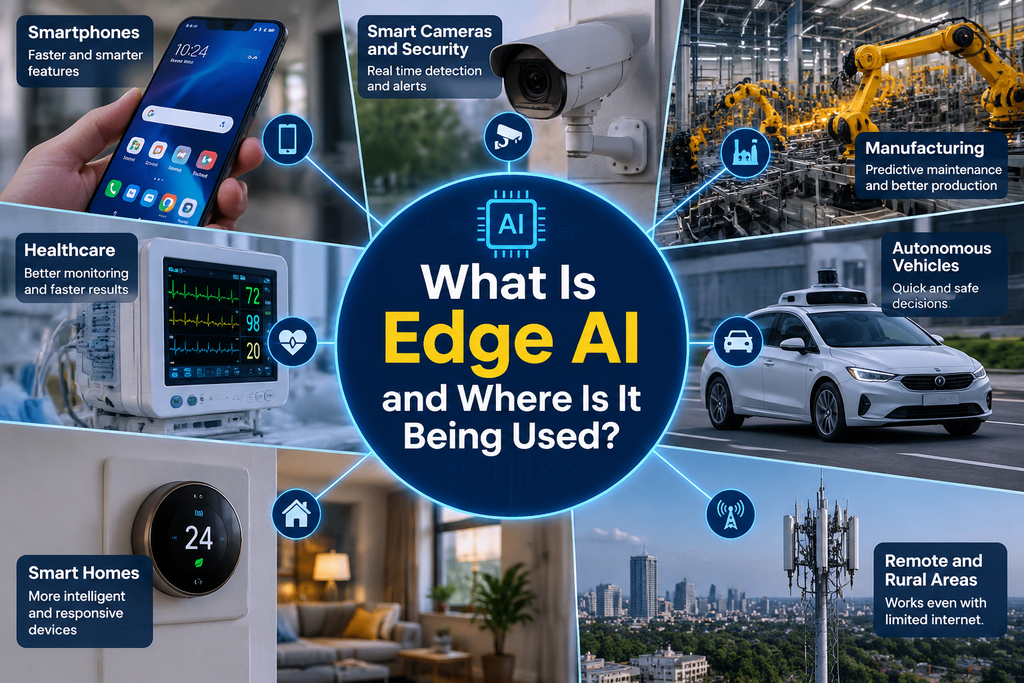
Edge AI in Manufacturing
Factories are using Edge AI to improve production and reduce equipment failures. Modern industrial machines generate huge amounts of data through sensors and monitoring systems.
Instead of sending all this data to the cloud, Edge AI systems analyze information directly inside factories. They can identify problems, predict machine failures, and improve production quality.
Predictive maintenance is one important application. AI systems can study machine behavior and detect early signs of damage before a serious failure occurs. This helps companies reduce downtime and maintenance costs.
Edge AI in Autonomous Vehicles
Autonomous vehicles depend heavily on artificial intelligence. Cars must understand their surroundings, recognize objects, and make decisions quickly.
Edge AI allows vehicles to process information from cameras, sensors, and radar systems locally. This helps vehicles respond faster to changing road conditions.
Self driving technology requires extremely fast decision making. Edge AI provides the necessary speed and reliability for advanced transportation systems.
Edge AI in Smart Homes
Smart homes are becoming more intelligent through Edge AI. Devices such as smart speakers, security systems, thermostats, and appliances can use local AI processing.
A smart thermostat can learn user preferences and adjust temperature automatically. A smart security system can recognize family members and detect unusual activity.
Edge AI makes these devices faster and allows them to continue working even when internet service is interrupted.
Edge AI and the Future of Technology
The future of Edge AI looks promising as devices continue becoming more powerful. Advances in AI chips, processors, and machine learning models are making it possible to run complex AI applications on smaller devices.
More industries are expected to adopt Edge AI because of its speed, privacy benefits, and efficiency. From agriculture and transportation to education and retail, Edge AI will continue changing how technology interacts with people.
The combination of Edge AI and cloud AI will likely become the future approach. Cloud systems will handle large scale data processing and training, while Edge AI devices will manage quick decisions and real time tasks.
Challenges of Edge AI
Although Edge AI provides many advantages, it also has some challenges. Running advanced AI models on small devices requires powerful hardware and efficient software.
Developers must create AI models that are accurate but also small enough to run on limited devices. Security is another concern because edge devices can be physically accessed and may become targets for attacks.
Regular updates are also important to keep Edge AI systems accurate and secure. Companies need to maintain these devices carefully to ensure reliable performance.
Conclusion
Edge AI is transforming the way artificial intelligence works by bringing smart decision making closer to the devices that create data. Instead of depending completely on cloud servers, Edge AI allows smartphones, vehicles, cameras, machines, and smart devices to process information locally.
With faster responses, improved privacy, lower network costs, and better reliability, Edge AI is becoming an important technology for the future. It is already being used in healthcare, manufacturing, security, transportation, smartphones, and smart homes.
As artificial intelligence continues to develop, Edge AI will play a major role in creating smarter devices that can understand, analyze, and respond to the world around them in real time. The growth of Edge AI shows that the future of technology is not only about powerful computers in the cloud but also about intelligent devices working directly where people need them most.

Understanding RAM and Its Role in Computer Performance

How Browser Extensions Add New Features to Web Browsers

How Modern Computer Processors Handle Multiple Tasks
About The Author
