
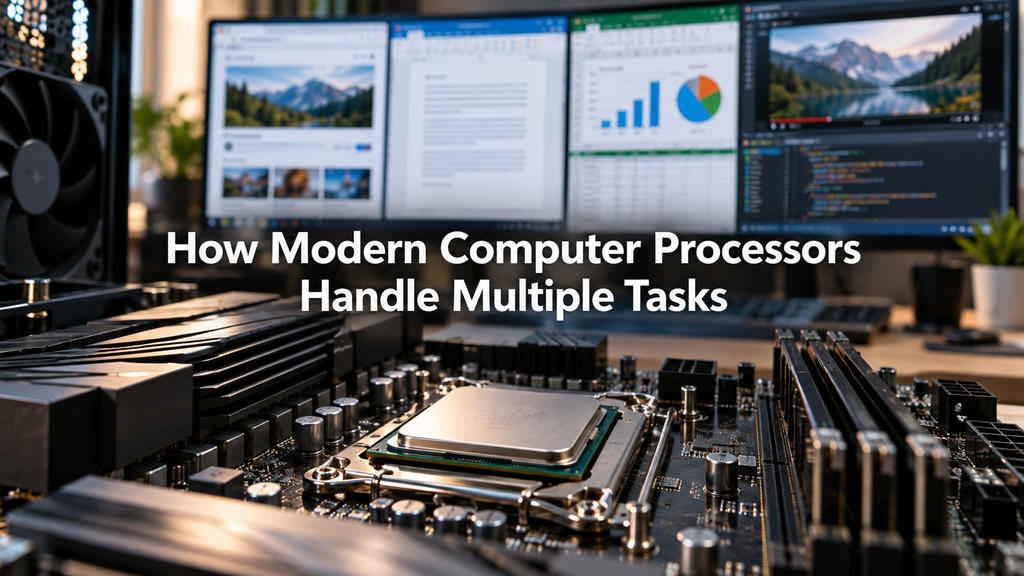
How Modern Computer Processors Handle Multiple Tasks
Modern computers are designed to perform many activities at the same time. A user can open a web browser, watch a video, download files, edit documents, listen to music, and run background applications without feeling that the computer is struggling. This smooth experience is possible because of modern computer processors and the advanced technologies built inside them.
The processor, also known as the CPU or Central Processing Unit, is often called the brain of a computer. It controls instructions, processes information, and manages communication between different hardware components. However, modern processors do much more than simply execute one task at a time. They use advanced techniques to handle multiple tasks efficiently and provide faster performance for everyday users.
Understanding how modern computer processors handle multiple tasks helps us understand why newer computers feel faster, why some processors perform better than others, and how technology continues to improve.
The Role of a Computer Processor
A computer processor is responsible for executing instructions given by software programs. Every action performed on a computer, from opening a file to running a game, requires processing power. When a user clicks an application, the operating system sends instructions to the processor, which quickly analyzes and completes them.
In older computers, processors mainly focused on completing one instruction at a time. As software became more advanced and users started demanding better performance, processors needed new methods to manage several activities together.
Modern computer processors solve this challenge by using multiple cores, threads, faster memory communication, and intelligent task management systems.
Multiple Cores Improve Multitasking Performance
One of the biggest improvements in modern processors is the introduction of multiple cores. A core is an individual processing unit inside a CPU that can handle instructions independently.
Older processors often had a single core, which meant they had to switch between tasks quickly. Although this switching happened very fast, the processor could only focus on one instruction stream at a time.
Modern processors can have several cores. For example, a processor with eight cores can handle multiple groups of instructions simultaneously. One core may manage a web browser, another may process background updates, while other cores handle video playback or creative software.
More cores generally improve multitasking performance because the workload can be divided among different processing units.
Understanding Threads in Modern Processors
Threads are another important technology that helps processors manage multiple tasks. A thread represents a sequence of instructions that a processor can handle.
Many modern processors use a technology called simultaneous multithreading. This allows a single core to handle more than one thread at a time. Instead of leaving parts of the core unused, the processor can work on different instruction streams more efficiently.
For example, while one part of a core is waiting for data, another thread can continue processing. This improves overall performance and allows computers to handle demanding workloads more smoothly.
Threads are especially useful for activities such as video editing, software development, 3D rendering, and running multiple applications together.
How Processors Switch Between Tasks
Even with multiple cores and threads, computers still need a system to organize tasks. This responsibility is handled by the operating system.
The operating system uses a process called task scheduling. It decides which applications receive processor resources and when they should run.
For example, if you are typing a document while music is playing in the background, the operating system quickly assigns processor time to both activities. The processor switches between tasks so rapidly that users feel everything is happening at the same moment.
This process is called multitasking. It allows computers to provide a smooth experience even when many applications are running.
The Importance of Processor Speed
Processor speed, usually measured in gigahertz, affects how quickly a CPU can execute instructions. A higher clock speed means the processor can complete more cycles per second.
However, processor performance is not only about clock speed. A modern processor with more cores, better architecture, and improved efficiency can outperform an older processor with a higher clock speed.
Manufacturers design processors with balanced performance by improving speed, power efficiency, and the ability to manage multiple tasks.
Cache Memory Helps Processors Work Faster
Cache memory is a small amount of extremely fast memory located inside the processor. It stores frequently used data and instructions so the CPU can access them quickly.
When a processor handles multiple tasks, it constantly needs information from memory. Accessing the main system memory takes more time, so the processor uses cache memory to reduce delays.
Modern processors usually have multiple levels of cache, including L1, L2, and L3 cache. These different levels help organize information and improve processing speed.
For example, when you repeatedly use the same application, important data may remain available in the cache, allowing the processor to respond faster.
The Role of Artificial Intelligence in Processor Management
Modern processors are becoming smarter with the help of artificial intelligence and machine learning technologies. Some processors can analyze workload patterns and automatically adjust performance.
For example, when a user launches a demanding game or professional editing software, the processor can increase performance where needed. When the computer is performing simple tasks, it can reduce power consumption.
This intelligent management improves both speed and battery life, especially in laptops and mobile devices.
Graphics Processing and CPU Cooperation
Many modern tasks require both the CPU and GPU to work together. The CPU handles general instructions, while the GPU specializes in graphics and parallel calculations.
When watching high resolution videos, playing games, or using creative applications, the processor communicates with the graphics unit to divide the workload.
This cooperation allows computers to perform complex tasks more efficiently. Instead of forcing one component to handle everything, modern systems distribute responsibilities among different hardware parts.
How Modern Processors Handle Background Tasks
Many computer activities happen in the background without users noticing. These include security scans, software updates, cloud synchronization, and system maintenance.
Modern processors are designed to manage these background activities while keeping the computer responsive. The operating system prioritizes important tasks and reduces the impact of less important processes.
For example, if you are writing an important document, the processor ensures that your typing remains smooth even if another application is downloading updates.
This ability is one reason modern computers can handle many programs at once without slowing down significantly.
Power Efficiency and Smart Performance
Modern processors are not only focused on speed. They are also designed to use energy efficiently.
Laptop processors especially need to balance performance and battery life. They can increase power when demanding tasks require more speed and reduce power during simple activities like browsing or reading documents.
Technologies such as dynamic frequency scaling allow processors to adjust their speed based on workload. This helps reduce heat generation and improves battery performance.
Multitasking in Everyday Life
Most people use multitasking every day without thinking about the technology behind it. A student may research online, write notes, attend a video meeting, and play educational videos at the same time.
A professional may edit photos, manage emails, analyze data, and communicate with colleagues using different applications.
Modern computer processors make these activities possible by efficiently managing thousands or millions of instructions every second.
The Future of Computer Processor Technology
Processor technology continues to develop rapidly. Future processors are expected to include more powerful cores, improved artificial intelligence features, better energy efficiency, and advanced designs for specialized tasks.
Companies are also exploring new processor architectures that can deliver higher performance while consuming less power. As software becomes more advanced, processors will continue evolving to meet increasing demands.
The future of computing will depend on processors that can handle complex workloads faster and more intelligently.
Conclusion
Modern computer processors handle multiple tasks through a combination of advanced technologies such as multiple cores, threads, intelligent scheduling, cache memory, and efficient power management. These improvements allow computers to perform many activities smoothly without users experiencing delays.
The ability of a processor to manage multiple tasks is one of the main reasons modern computers are faster and more reliable than previous generations. Whether someone is working, studying, creating content, or enjoying entertainment, the processor plays a central role in delivering a smooth digital experience.
As technology continues to advance, computer processors will become even more powerful and efficient, making future devices capable of handling more complex tasks with greater speed and intelligence. Understanding how processors work helps us appreciate the technology that powers our everyday digital world.

Understanding Bluetooth and Its Everyday Uses

How Digital Note Taking Tools Organize Information

How Browser Extensions Add New Features to Web Browsers
About The Author
