
How Smart Home Devices Communicate With Each Other
Smart home technology has changed the way people interact with their homes. In the past, a home was considered smart when it had basic electronic systems like automatic lights or security alarms. Today, smart homes include many connected devices that can communicate with each other and perform tasks automatically. From smart speakers and smart lights to security cameras, thermostats, and kitchen appliances, these devices work together to make daily life easier, safer, and more comfortable.
The main idea behind a smart home is communication. A smart device alone can perform certain functions, but when multiple devices connect and share information, they become part of a complete smart home system. Understanding how smart home devices communicate with each other helps us see how modern homes are becoming more intelligent and efficient.
What Are Smart Home Devices?
Smart home devices are electronic products that can connect to the internet or communicate with other devices through wireless networks. These devices usually have sensors, software, and communication technology that allow them to collect information and respond to commands.
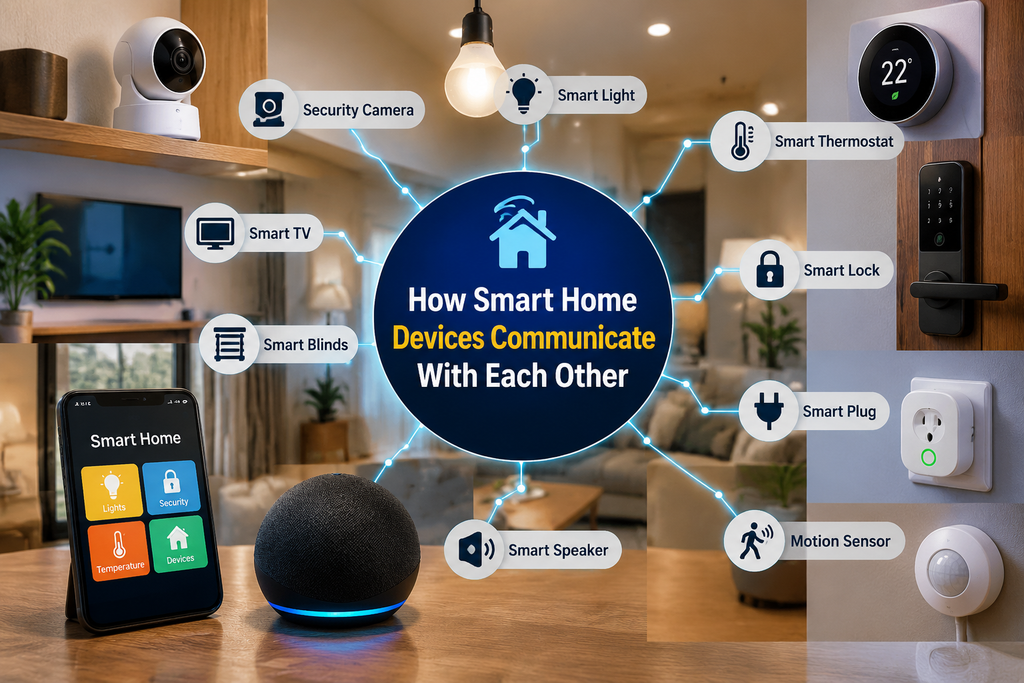
Examples of smart home devices include smart bulbs that adjust brightness, smart thermostats that control room temperature, smart door locks that provide keyless entry, smart cameras that monitor homes, and smart speakers that control other connected devices.
Unlike traditional electronic products, smart home devices can receive instructions, analyze data, and work automatically based on user preferences. For example, a smart thermostat can learn a person’s daily routine and adjust the temperature without manual control.
The Role of Internet Connection in Smart Homes
One of the most important parts of smart home communication is the internet. Many smart devices connect to the home Wi Fi network to send and receive information. Through the internet, devices can communicate with mobile applications and cloud platforms.
For example, when a person uses a smartphone app to turn on a smart light while sitting outside the home, the command travels through the internet to the cloud system and then reaches the smart light. The light receives the instruction and turns on within seconds.
Internet connectivity also allows users to control their homes from anywhere. A person can check security cameras, lock doors, or adjust temperature even when they are away from home.
However, not every smart device depends completely on the internet. Some devices communicate directly with each other using local wireless technologies.
How Wi Fi Helps Smart Devices Communicate
Wi Fi is one of the most common communication methods used in smart homes. Most smart devices use Wi Fi because it provides fast data transfer and allows connection to existing home networks.
Smart cameras, smart televisions, smart speakers, and many other devices use Wi Fi to communicate. A smart speaker connected to Wi Fi can receive voice commands and send instructions to other devices.
For example, when a user says, “Turn off the living room lights,” the smart speaker processes the command and communicates with the smart bulbs through the network. The bulbs then respond and complete the action.
The advantage of Wi Fi is that it supports high data usage. This makes it useful for devices that send large amounts of information, such as security cameras that stream video.
Bluetooth Communication in Smart Homes
Bluetooth is another important technology used in smart home devices. It is mainly used for short distance communication between devices.
Many smart locks, speakers, fitness devices, and small sensors use Bluetooth because it requires less energy compared to Wi Fi. For example, a smart door lock can communicate with a smartphone through Bluetooth when the user is nearby.
Bluetooth is especially useful for battery powered devices because it helps extend battery life. However, because its range is limited, it is usually used for specific situations rather than controlling an entire home.
Zigbee and Z Wave Technology
Besides Wi Fi and Bluetooth, many smart home devices use special communication technologies called Zigbee and Z Wave. These technologies are designed specifically for smart home environments.
Zigbee allows devices to create a network where they can communicate with each other without depending completely on Wi Fi. Many smart lights, sensors, and switches use Zigbee because it consumes very little energy.
Z Wave works in a similar way and is commonly used for smart security systems, lighting controls, and home automation products. These technologies help create reliable connections between multiple devices.
A major benefit of Zigbee and Z Wave is that they support mesh networking. In a mesh network, each device can help pass information to another device. This means the network can cover a larger area because devices work together to send signals.
The Importance of Smart Home Hubs
A smart home hub acts as a central communication point between different devices. Many smart home products use different communication methods, so a hub helps connect them together.
For example, a smart light may use Zigbee while a smart camera may use Wi Fi. The hub allows these devices to work together even though they use different technologies.
When a user gives a command through a smart assistant, the hub receives the instruction, understands which device needs to respond, and sends the correct message.
Modern smart home systems are becoming simpler because many new devices can connect directly without requiring separate hubs. However, hubs are still useful in larger homes with many connected devices.
The Role of Smart Assistants
Smart assistants have become an important part of home communication. Devices like smart speakers use artificial intelligence to understand voice commands and control connected products.
When a person gives a voice command, the smart assistant converts the spoken words into digital instructions. It then communicates with the required device through the home network.
For example, a user can say, “Make the bedroom warmer.” The smart assistant sends a message to the smart thermostat, which adjusts the temperature automatically.
Smart assistants also allow users to create routines. A morning routine can turn on lights, start coffee machines, and provide weather information automatically.
How Sensors Help Devices Share Information
Sensors are the eyes and ears of smart home systems. They collect information about the environment and share it with other devices.
Motion sensors can detect movement and tell lights to turn on automatically. Temperature sensors can provide information to smart thermostats. Door sensors can notify security systems when someone enters or leaves.
For example, when a motion sensor detects movement at night, it can communicate with smart lights and activate them. This reduces the need for manual control and improves convenience.
Cloud Technology and Smart Home Communication
Cloud technology plays a major role in modern smart homes. Many smart devices store information and process commands through cloud servers.
The cloud allows devices to receive software updates, store user settings, and provide remote access. It also helps companies improve device performance by analyzing information from connected products.
For example, a smart security camera can store recorded videos in cloud storage and allow users to watch them from anywhere.
Although cloud technology provides many benefits, security and privacy are important concerns. Smart home manufacturers must protect user information from unauthorized access.
Security Challenges in Smart Home Communication
As more devices become connected, security becomes an important issue. Every connected device creates another possible entry point for cyber threats.
Smart home users should use strong passwords, update device software regularly, and choose products from trusted manufacturers. Secure networks and encryption methods help protect communication between devices.
Manufacturers are also improving security features by adding better authentication systems and stronger data protection methods.
The Future of Smart Home Communication
The future of smart homes will bring even better communication between devices. New technologies are making smart homes more intelligent, efficient, and easier to manage.
Artificial intelligence will allow devices to understand user habits and make decisions automatically. For example, a smart home system may learn when people usually wake up, leave home, or relax and adjust settings accordingly.
Another important development is Matter, a new smart home communication standard designed to improve compatibility between different brands. It aims to make it easier for devices from different companies to work together.
In the future, smart homes may become more personalized and environmentally friendly. Devices will communicate more effectively to reduce energy waste and improve comfort.
Conclusion
Smart home devices communicate with each other through different technologies such as Wi Fi, Bluetooth, Zigbee, Z Wave, and cloud systems. These communication methods allow devices to share information, respond to commands, and work together as one connected system.
The true power of a smart home comes from cooperation between different devices. A smart light, thermostat, security camera, and speaker become much more useful when they can communicate and understand each other.
As technology continues to improve, smart home communication will become faster, safer, and more intelligent. Connected homes are not only about convenience but also about creating living spaces that adapt to human needs and make everyday life easier.

Understanding NFC Technology and Its Everyday Applications

How E Ink Displays Differ From Traditional Screens

What Is Edge Computing and Why Does It Matter
About The Author
