What Digital Twins Are and How They Work
Introduction
Technology is changing the way people understand and manage the world around them. In the past, businesses and engineers had to depend on physical testing, manual inspections, and traditional methods to improve products and systems. Today, advanced technologies such as artificial intelligence, the Internet of Things, and data analytics are helping organizations make smarter decisions. One of the most interesting developments in modern technology is the concept of digital twins.
A digital twin is a virtual copy of a physical object, process, or system that uses real time data to represent its real world counterpart. It allows people to study, monitor, and improve physical things without always needing to interact with them directly. From factories and vehicles to buildings and healthcare systems, digital twins are becoming an important part of digital transformation.
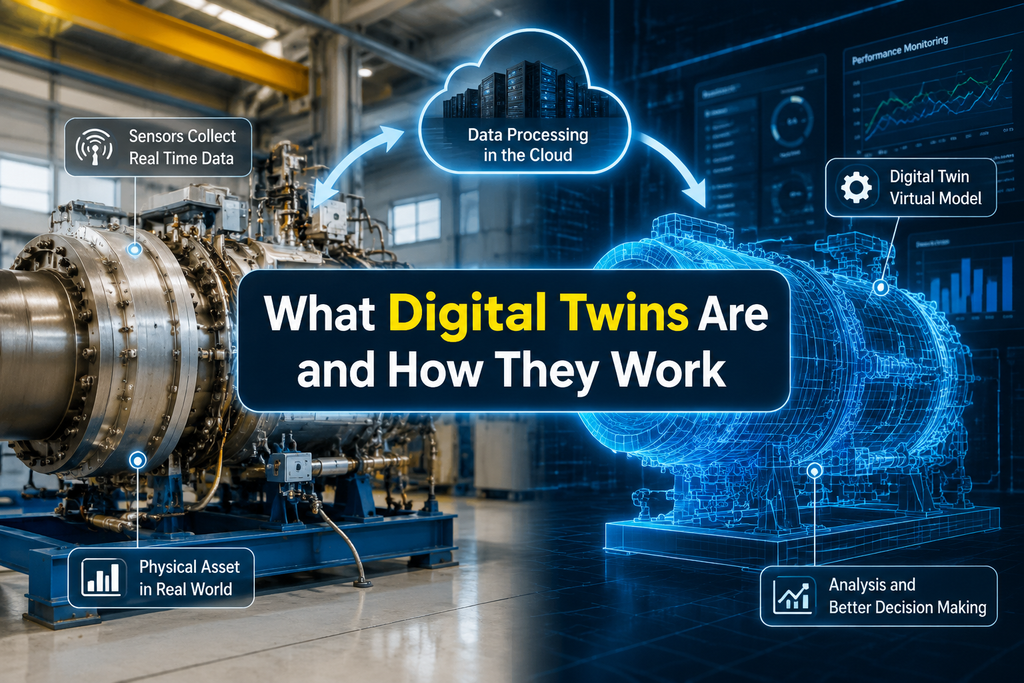
The idea behind digital twins is simple. When a physical object exists in the real world, a digital version of that object can be created using software. This digital model receives information from sensors and other connected devices, allowing it to behave like the original object. Engineers and businesses can then analyze performance, predict problems, and find better solutions.
What Is a Digital Twin?
A digital twin is a computer based model that represents a real world object, machine, or process. Unlike a simple 3D model or computer simulation, a digital twin is connected to the actual physical object through data. This connection allows the digital twin to change and update as the real object changes.
For example, imagine a modern airplane engine equipped with thousands of sensors. These sensors collect information about temperature, pressure, vibration, and performance. This information is sent to a digital twin of the engine. Engineers can observe the digital version to understand how the real engine is working and identify possible issues before they become serious problems.
A digital twin can represent many different things. It can be a small device, such as a smartphone component, or a large system, such as an entire city. Companies use digital twins to improve efficiency, reduce costs, and make better decisions.
The main purpose of a digital twin is to create a connection between the physical world and the digital world. This connection helps people understand how things work and how they can be improved.
How Digital Twins Work
Digital twins work by combining several modern technologies. The process usually starts with collecting data from a physical object. Sensors, cameras, and connected devices gather information about the object’s condition and performance.
This data is then transferred to a digital platform where the digital twin is created and updated. Advanced software processes the information and creates a virtual representation of the physical object.
Artificial intelligence and machine learning often play an important role in digital twins. These technologies analyze large amounts of data and identify patterns that humans may not notice. For example, a digital twin of a machine in a factory can detect unusual vibrations and predict when maintenance might be needed.
The digital twin continues receiving new information from the physical object. This means it is not a fixed model. Instead, it changes over time based on real world conditions. This continuous connection makes digital twins powerful tools for monitoring and decision making.
The Main Components of a Digital Twin
A digital twin system usually contains several important components that work together.
The first component is the physical object. This can be anything from a machine, vehicle, building, or industrial system. The physical object produces real world information that is needed for the digital twin.
The second component is sensors and data collection devices. These devices collect information such as temperature, movement, speed, energy usage, and other important measurements.
The third component is the digital model. This is the virtual representation created using software. It shows how the physical object looks and behaves.
The fourth component is data processing technology. Cloud computing, artificial intelligence, and analytics tools help process information and provide useful insights.
The final component is the connection between the physical and digital versions. This connection allows information to move in both directions. Data from the physical object updates the digital twin, while information from the digital twin can help improve the physical object.
Types of Digital Twins
Digital twins can be created for different purposes and at different levels of complexity.
A component digital twin focuses on a single part of a larger system. For example, a company may create a digital twin of a machine part to study its performance and durability.
An asset digital twin represents a complete physical object. For example, a digital twin of a wind turbine can show how the entire turbine operates.
A system digital twin represents multiple connected assets working together. For example, a factory digital twin can include machines, production lines, and energy systems.
A process digital twin focuses on the complete workflow or operation. Businesses use these types of digital twins to improve production methods and identify areas where efficiency can be increased.
Applications of Digital Twins
Digital twin technology is being used in many industries because of its ability to improve planning and performance.
Manufacturing
Manufacturing is one of the biggest areas where digital twins are used. Factories create digital copies of machines and production systems to monitor operations. This helps manufacturers reduce downtime, improve product quality, and predict equipment failures.
Before making changes to a production line, engineers can test ideas using a digital twin. This reduces risk because they can understand possible results before applying changes in the real world.
Healthcare
Digital twins are also creating new possibilities in healthcare. Doctors and researchers can use digital models to study human health and develop personalized treatment plans.
For example, a digital twin of a patient’s organ can help doctors understand how different treatments may affect the patient. This technology may support more accurate diagnosis and better healthcare decisions in the future.
Smart Cities
Cities are becoming more complex, and managing resources efficiently is a major challenge. Digital twins help city planners create virtual models of roads, buildings, transportation systems, and energy networks.
A smart city digital twin can help analyze traffic patterns, improve public services, and support better urban planning.
Automotive Industry
Car manufacturers use digital twins to design and test vehicles. Engineers can study vehicle performance, safety, and fuel efficiency using virtual models before building physical prototypes.
Electric vehicle companies also use digital twins to monitor battery performance and improve vehicle reliability.
Construction and Architecture
In construction, digital twins help architects and engineers manage buildings throughout their entire lifecycle. A digital twin can provide information about energy use, maintenance needs, and structural conditions.
Building owners can use this information to reduce costs and improve building performance.
Benefits of Digital Twin Technology
Digital twins provide many advantages for businesses and organizations.
One major benefit is improved decision making. Instead of relying only on assumptions, companies can use real time information to make informed choices.
Another benefit is predictive maintenance. Traditional maintenance often happens after a problem occurs or according to a fixed schedule. Digital twins can predict problems before equipment fails, helping companies save time and money.
Digital twins also improve efficiency. By analyzing processes and identifying weaknesses, organizations can find better ways to use resources.
Safety is another important advantage. Engineers can test dangerous situations in a digital environment instead of risking damage or injury in the real world.
Digital twins also support innovation because companies can experiment with new ideas before applying them physically.
Challenges of Digital Twins
Although digital twins offer many benefits, they also have some challenges.
One challenge is the large amount of data required. Digital twins depend on accurate and continuous data collection. Managing this information requires strong computer systems and advanced technology.
Security is another concern. Since digital twins are connected to physical systems, protecting data from cyber threats is extremely important.
Creating a digital twin can also require significant investment. Small organizations may find the cost of sensors, software, and infrastructure difficult.
Another challenge is complexity. Developing and maintaining an accurate digital twin requires skilled professionals who understand software, engineering, and data analysis.
The Future of Digital Twins
The future of digital twins looks promising as technology continues to improve. Advances in artificial intelligence, cloud computing, and Internet of Things devices are making digital twins more powerful and accessible.
In the coming years, more industries are expected to use digital twins for planning, monitoring, and improving their operations. Businesses may use digital twins not only for individual machines but also for complete organizations and environments.
As artificial intelligence becomes more advanced, digital twins may become capable of making automatic decisions and suggesting improvements without constant human involvement.
The combination of real time data and intelligent analysis will continue changing how people design, build, and manage physical systems.
Conclusion
Digital twins represent an important connection between the physical world and the digital world. By creating virtual copies of real objects and systems, this technology allows businesses, engineers, and researchers to understand performance, predict problems, and improve efficiency.
The working principle of digital twins depends on sensors, data collection, artificial intelligence, and continuous communication between physical and digital systems. From manufacturing and healthcare to smart cities and transportation, digital twins are already changing many industries.
As technology develops further, digital twins will become an even more important tool for innovation and problem solving. They are not just virtual models but powerful systems that help people make smarter decisions and create a more efficient future.

How QR Codes Store and Share Information

What Is Edge Computing and Why Does It Matter

How E Ink Displays Differ From Traditional Screens
About The Author
