How Digital Note Taking Tools Organize Information
In today’s digital world, information is increasing faster than ever before. People read articles, attend online classes, join meetings, save ideas, collect research material, and manage daily tasks. Keeping all this information organized can become difficult if we depend only on traditional notebooks and scattered papers. This is where digital note taking tools have changed the way people collect, store, and manage information.
Digital note taking tools are software applications that allow users to create, edit, organize, and access notes using computers, tablets, and smartphones. These tools help students, professionals, researchers, and everyday users keep their information in one place. Instead of searching through pages of notebooks, users can quickly find important details with simple searches and smart organization features.
The popularity of digital note taking tools has grown because they make information management easier and more efficient. From simple text notes to images, audio recordings, documents, and task lists, these platforms provide many ways to organize knowledge. Understanding how digital note taking tools work can help people improve productivity and manage their information better.
What Are Digital Note Taking Tools?
Digital note taking tools are applications designed to help users create and manage electronic notes. Unlike traditional notebooks, these tools offer advanced features that make storing information faster and more flexible.
A digital note can include written text, pictures, website links, voice recordings, drawings, scanned documents, and even videos. This allows users to collect different types of information in a single place. For example, a student can write lecture notes, attach a PDF book chapter, add a picture of a classroom board, and create a task list for an assignment in one digital notebook.
Many digital note taking tools also allow synchronization across multiple devices. A person can create a note on a laptop and later open the same note on a smartphone. This makes information available anytime and anywhere.
How Digital Note Taking Tools Organize Information
The main purpose of digital note taking tools is to organize information in a structured way. They provide different features that help users arrange their notes according to topics, importance, and personal needs.
Creating Digital Notebooks and Folders
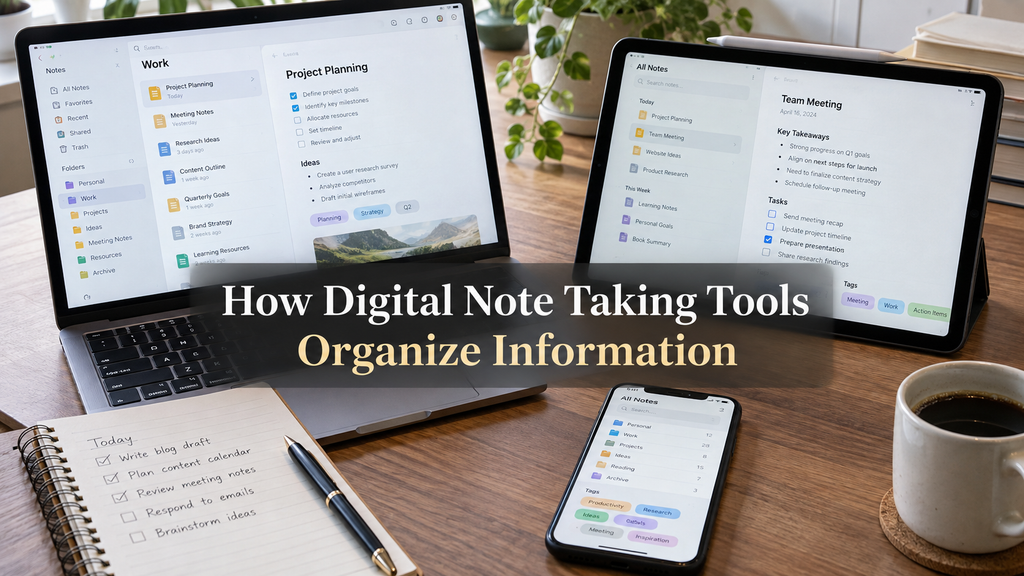
One of the most common organization methods in digital note taking tools is the use of notebooks and folders. Users can create separate sections for different areas of life.
For example, a university student may create folders for subjects like computer science, mathematics, and history. A business professional may create folders for meetings, projects, and future ideas.
This structure keeps information separated and prevents confusion. Instead of having hundreds of pages mixed together, users can quickly open the correct category and find what they need.
Using Tags to Find Information Quickly
Tags are another powerful feature that helps organize digital notes. A tag is a simple keyword attached to a note to describe its topic or purpose.
For example, a person may create tags like “work,” “research,” “ideas,” or “important.” Later, searching for a specific tag will show all related notes.
Tags are useful because one note can belong to multiple categories. A note about a business idea could have tags such as “startup,” “finance,” and “planning.” This makes information easier to discover without creating multiple copies of the same note.
Powerful Search Features
One of the biggest advantages of digital note taking tools is their search capability. Finding information in a paper notebook can take several minutes, especially when there are many pages. Digital tools can locate information within seconds.
Most applications allow users to search words, phrases, and even text inside images. Some advanced tools use artificial intelligence to understand the meaning of notes and provide better search results.
For example, if someone saved information about a travel plan months ago, they do not need to remember the exact folder location. They can simply type related words and quickly find the saved information.
Synchronization Across Devices
Modern digital note taking tools help users access their information from different devices. Cloud synchronization automatically updates notes and keeps them available everywhere.
A person can write an idea on a smartphone while traveling and later continue editing it on a computer at home. This feature is especially useful for professionals and students who use multiple devices throughout the day.
Synchronization also provides protection against data loss. If a computer stops working, important notes can still be recovered from the cloud.
Adding Different Types of Information
Traditional notebooks mainly support written information, but digital note taking tools allow users to combine different formats.
Users can add images, screenshots, audio recordings, scanned documents, and website links. This creates a richer collection of information.
For example, a researcher studying a topic can save written observations, reference links, important images, and recorded thoughts in one organized note. This makes the learning and research process more complete.
Improving Learning and Study Methods
Digital note taking tools have become popular among students because they support better learning habits. Students can organize class notes, create revision plans, and save educational resources.
Features such as highlighting, checklists, and reminders help students focus on important information. Some tools also allow students to create digital flashcards and summaries for exam preparation.
Digital notes also make collaboration easier. Students working on group projects can share notes, add comments, and update information together.
Helping Professionals Manage Work
In professional environments, managing information is an important part of success. Digital note taking tools help employees organize meetings, project details, and business ideas.
During meetings, professionals can quickly write important points and create task lists. They can later review these notes and track progress.
For managers, digital notes provide a simple way to store information about different projects and teams. This reduces the chance of forgetting important details.
The Role of Artificial Intelligence in Digital Notes
Artificial intelligence is adding new possibilities to digital note taking tools. AI features can help users summarize long notes, organize information automatically, and suggest connections between ideas.
For example, after a long meeting, an AI powered note tool may help create a short summary of important points. This saves time and allows users to focus on decision making.
AI can also help improve search functions by understanding the context of information instead of only matching exact words.
Benefits of Using Digital Note Taking Tools
There are many advantages of using digital note taking tools in daily life.
The first benefit is better organization. Users can keep all important information arranged properly instead of storing documents in different locations.
The second benefit is improved productivity. Quick search options, reminders, and task lists help people complete work more efficiently.
Another advantage is accessibility. Digital notes can be opened from anywhere with an internet connection. This makes information management more flexible.
Digital note taking tools also reduce paper usage. By storing information electronically, users can contribute to environmentally friendly practices.
Popular Uses of Digital Note Taking Tools
Digital note taking tools are used in many areas of life. Students use them for lectures, assignments, and research. Teachers use them to prepare lessons and organize teaching materials.
Business owners use digital notes for planning, customer information, and business strategies. Writers use them to collect ideas and organize content.
Even everyday users benefit from these tools by saving recipes, personal goals, shopping lists, and important reminders.
Choosing the Right Digital Note Taking Tool
The best digital note taking tool depends on individual needs. Some people need simple applications for basic notes, while others require advanced features for professional work.
Before choosing a tool, users should consider factors such as ease of use, storage options, device compatibility, security features, and collaboration abilities.
A good note taking tool should feel comfortable and support the way a person naturally organizes information.
The Future of Digital Note Taking
The future of digital note taking tools is likely to become more intelligent and connected. Artificial intelligence, automation, and improved cloud technology will continue changing how people manage information.
Future tools may automatically organize notes, identify important details, and help users make better decisions from their stored knowledge.
As information continues to grow, effective organization will become even more important. Digital note taking tools will continue helping people control their information instead of feeling overwhelmed by it.
Conclusion
Digital note taking tools have transformed the way people collect and organize information. They provide a simple and powerful method to store ideas, manage tasks, save research, and access knowledge from anywhere.
Features like folders, tags, search options, synchronization, and artificial intelligence make these tools much more useful than traditional notebooks. Whether someone is a student, professional, researcher, or everyday user, digital note taking tools can improve organization and productivity.
As technology continues to develop, these tools will become even smarter and more helpful. Learning how to use digital note taking tools effectively can help people manage information better and stay prepared in a fast changing digital world.

Understanding Bluetooth and Its Everyday Uses

What Solid State Drives Change About Computer Storage

How Modern Computer Processors Handle Multiple Tasks
About The Author
