
What Li Fi Technology Could Mean for Wireless Connectivity
Introduction
Wireless communication has become an important part of modern life. From smartphones and laptops to smart homes and industrial machines, almost every device depends on wireless connectivity. Today, technologies like Wi Fi and Bluetooth allow people to share information without using cables. However, as the number of connected devices continues to increase, traditional wireless networks are facing new challenges such as limited bandwidth, network congestion, and security concerns.
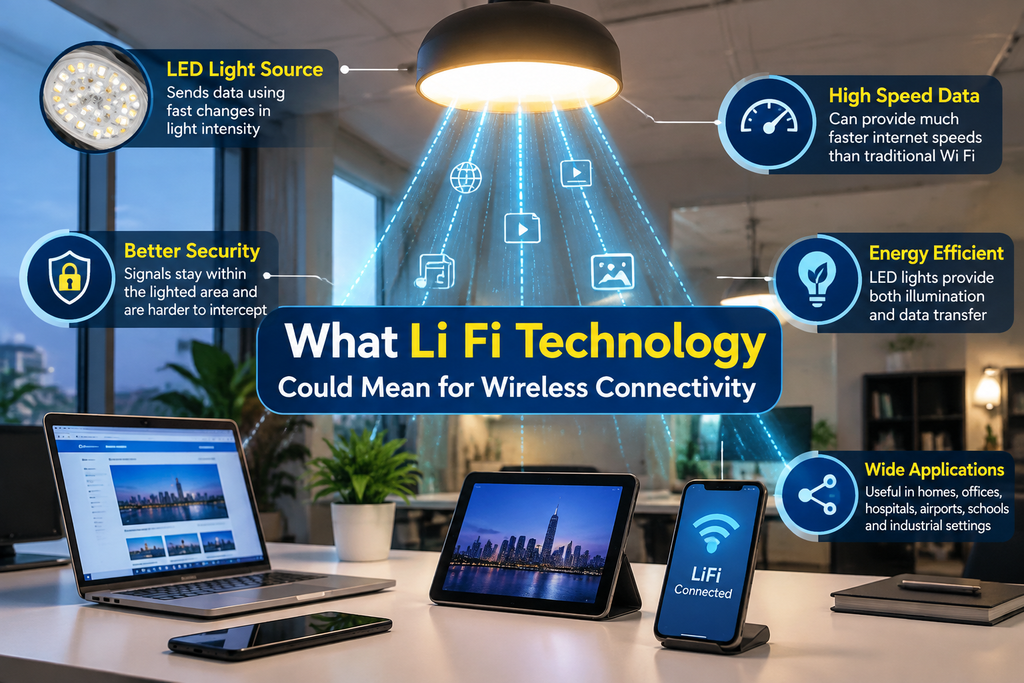
This is where Li Fi technology enters the picture. Li Fi, which stands for Light Fidelity, is an advanced wireless communication technology that uses light to transmit data instead of traditional radio waves. It works by using LED lights to send information through rapid changes in light intensity that are invisible to the human eye. These small changes happen at extremely high speeds, allowing data to move between devices.
Li Fi technology could change the future of wireless connectivity by providing faster speeds, improved security, and new possibilities for communication in places where traditional wireless systems have limitations. Although Li Fi is still developing, researchers and technology companies believe it could become an important part of future communication networks.
What Is Li Fi Technology?
Li Fi technology is a wireless communication system that uses visible light to transfer data. Unlike Wi Fi, which uses radio frequency signals, Li Fi depends on light waves produced by LED bulbs. These LED lights can switch on and off at very high speeds, creating a digital signal that carries information.
The human eye cannot detect these changes because they happen much faster than we can see. A Li Fi enabled device contains a receiver that captures these light signals and converts them into useful data. In simple words, a light bulb becomes a communication tool that can provide internet access while also providing normal lighting.
The idea behind Li Fi was introduced by Professor Harald Haas in 2011 during a technology demonstration. His research showed that ordinary LED lights could be used to transmit data at high speeds. Since then, Li Fi technology has continued to improve through research and testing.
How Does Li Fi Work?
The working process of Li Fi technology is based on a method called visible light communication. The main component is an LED light source connected to a data network.
When information needs to be transmitted, the LED light changes its brightness patterns at very high speeds. These changes represent digital information. A receiver device, such as a smartphone or computer with Li Fi capability, detects these light variations and converts them back into electronic data.
The process is similar to how a television remote uses infrared signals, but Li Fi uses visible light and can carry much larger amounts of information. Because LED lights can change states millions of times per second, they have the potential to provide very fast internet connections.
Li Fi requires a direct or indirect light path between the transmitter and receiver. This means that objects blocking the light may interrupt the connection. However, advanced systems are being developed to overcome these limitations.
Li Fi Compared With Wi Fi
Wi Fi is currently the most common wireless technology used around the world. It uses radio waves to connect devices to the internet. Li Fi takes a different approach by using light waves.
One major difference between Li Fi and Wi Fi is the communication medium. Wi Fi uses radio frequencies, while Li Fi uses visible light. This difference creates several advantages and disadvantages.
Li Fi has the potential to offer much higher data transfer speeds because the visible light spectrum is much larger than the radio frequency spectrum. This means more space is available for sending information.
Another difference is security. Wi Fi signals can travel through walls, which makes them convenient but also increases the risk of unauthorized access. Li Fi signals generally remain within the area illuminated by the light source, making it more difficult for outsiders to intercept the connection.
However, Wi Fi has an important advantage because it can work through walls and does not require a visible light connection. Li Fi currently works best in environments where light sources and devices have a clear connection.
In the future, Li Fi and Wi Fi may work together rather than replace each other. A combination of both technologies could provide faster, more reliable, and flexible wireless networks.
Benefits of Li Fi Technology
Faster Internet Speeds
One of the biggest advantages of Li Fi technology is its potential for extremely fast data transmission. Because visible light has a much wider spectrum than radio frequencies, Li Fi can support higher data capacity.
This could be useful in situations where many devices need high speed connections. For example, airports, universities, offices, and smart cities could benefit from faster wireless communication.
Improved Security
Security is a major concern in wireless communication. Since Li Fi signals usually do not pass through walls, the communication area is more controlled. This makes it harder for hackers outside a building to access the network.
Businesses, government organizations, and research facilities that handle sensitive information may find Li Fi useful because it provides an additional layer of security.
Reduced Network Congestion
The increasing number of connected devices is creating pressure on existing wireless networks. Smartphones, smart watches, home appliances, and industrial systems all compete for wireless bandwidth.
Li Fi can reduce this pressure by using a different part of the electromagnetic spectrum. Instead of depending only on radio waves, future networks could use light based communication to handle additional data traffic.
Energy Efficiency
LED lights are already known for their energy efficiency. When combined with communication technology, the same lighting system can provide both illumination and data transfer.
This could reduce the need for separate networking equipment in some environments and support the development of smarter buildings.
Applications of Li Fi Technology
Li Fi technology has many possible applications across different industries.
Smart Homes
In future smart homes, Li Fi could allow household devices to communicate through lighting systems. Smart televisions, security cameras, and home assistants could connect through Li Fi enabled lights.
This could create faster and more secure home networks while reducing dependence on traditional wireless systems.
Healthcare
Hospitals require reliable and secure communication systems. Traditional wireless signals can sometimes interfere with sensitive medical equipment.
Because Li Fi uses light instead of radio waves, it could provide a safer communication option in medical environments. Doctors could use Li Fi networks for patient monitoring systems, medical devices, and data sharing.
Aviation
Airplanes have strict rules regarding wireless communication because radio signals can create interference concerns. Li Fi could provide passengers with high speed internet access through cabin lighting systems.
Airlines could use Li Fi technology to improve passenger experience while maintaining communication safety.
Education
Schools and universities could benefit from Li Fi enabled classrooms. Students could access digital learning materials through classroom lights without depending only on crowded Wi Fi networks.
This could improve online learning experiences and support modern educational systems.
Industrial Automation
Factories are becoming more connected through automation and smart machines. Li Fi could help industrial equipment communicate quickly and securely.
Manufacturing environments with many connected devices could use Li Fi to improve efficiency and data exchange.
Challenges of Li Fi Technology
Although Li Fi offers many advantages, it also faces several challenges before becoming widely available.
One major limitation is the requirement for light. Since Li Fi depends on LED signals, communication can be affected when the light source is blocked or turned off.
Another challenge is infrastructure. Most buildings already have Wi Fi networks, while Li Fi requires specialized lights and compatible devices. Large scale adoption will require investment in new systems.
Device compatibility is also an important issue. Smartphones, computers, and other devices need special hardware to communicate through Li Fi. As the technology develops, manufacturers will need to include Li Fi receivers in more products.
Cost is another factor. Although LED technology is affordable, creating advanced Li Fi networks may require additional equipment and installation.
The Future of Li Fi Technology
The future of Li Fi technology looks promising as demand for faster and more secure wireless connectivity continues to grow. Researchers are working to improve range, reliability, and compatibility with existing networks.
Li Fi is not expected to completely replace Wi Fi. Instead, both technologies may work together to create hybrid networks. Wi Fi could provide general coverage, while Li Fi could deliver high speed connections in specific areas.
Future cities may use Li Fi in streetlights, offices, transportation systems, and public spaces. Smart lighting networks could become communication networks, creating new opportunities for connected environments.
As more devices become part of the Internet of Things, technologies like Li Fi could help manage the massive amount of data generated by these devices.
Conclusion
Li Fi technology represents an exciting development in the world of wireless communication. By using light to transmit data, it offers a new approach to solving some challenges faced by traditional wireless networks.
With the potential for faster speeds, improved security, lower congestion, and energy efficient communication, Li Fi could play an important role in the future of connectivity. Although challenges such as limited range and infrastructure requirements remain, ongoing research continues to improve this technology.
The future of wireless communication may not depend on a single technology. Instead, a combination of different systems could create faster, smarter, and more reliable networks. Li Fi technology could become an important part of this future by turning ordinary lights into powerful communication tools. As digital connections continue to expand, Li Fi may help shape the next generation of wireless connectivity.

What Digital Twins Are and How They Work

What Is Edge Computing and Why Does It Matter

How QR Codes Store and Share Information
About The Author
