
How 5G Technology Changes the Smartphone Experience
Smartphones have changed a lot over the years. At first, mobile phones were mainly used for calling and sending text messages. Later, smartphones introduced internet browsing, social media, online shopping, video streaming, mobile banking, gaming, and many other useful features. Today, smartphones have become an important part of daily life.
One of the biggest developments in recent mobile technology is 5G.
5G technology is designed to provide faster internet speeds, lower delay, stronger network capacity, and better support for connected devices. These improvements can change the way people use smartphones in everyday situations.
When I first started reading about 5G, I thought it was simply a faster version of 4G. However, after learning more about how mobile networks work, I realized that 5G is not only about downloading files more quickly. It can also improve video streaming, gaming, communication, cloud services, navigation, smart devices, and many other smartphone experiences.
This article explains how 5G technology changes the smartphone experience, why it matters, and what users can realistically expect from it.
What Is 5G Technology?
5G stands for fifth generation mobile network technology. It comes after earlier generations such as 2G, 3G, and 4G.
Each generation of mobile technology has introduced major improvements.
2G made digital mobile communication more practical.
3G improved mobile internet access.
4G made fast smartphone internet, video streaming, and mobile apps much more useful.
5G takes another step forward by improving speed, network response time, capacity, and overall connectivity.
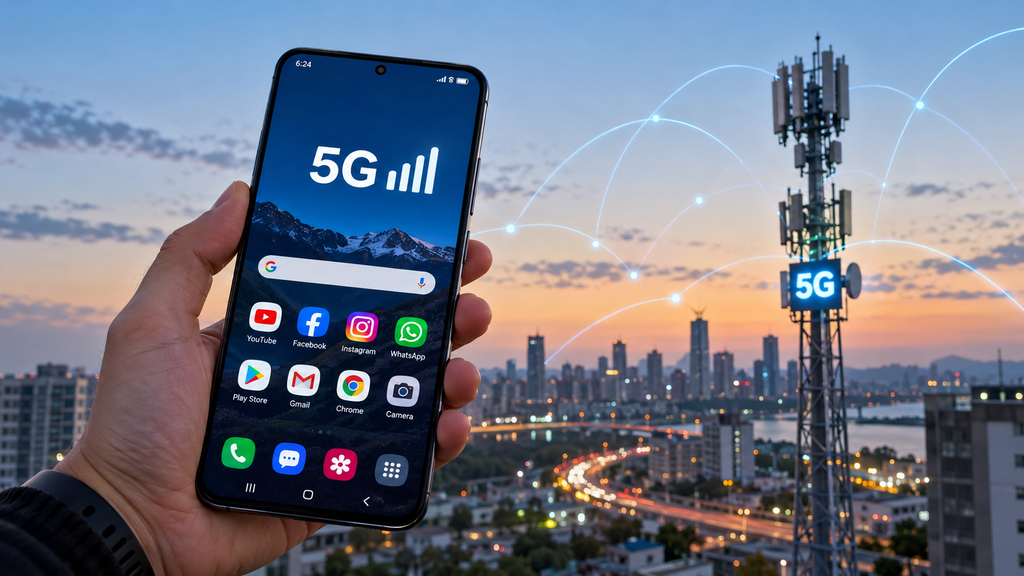
A 5G smartphone connects to compatible mobile towers and network equipment. Depending on the location, network conditions, frequency bands, and mobile operator, users may experience significantly faster data performance than they would on older mobile networks.
However, the real experience varies. A phone displaying a 5G symbol does not automatically mean that the user will always receive extremely high speeds.
Faster Internet Speeds on Smartphones
One of the most noticeable benefits of 5G technology is faster mobile internet.
Smartphone users regularly download apps, watch videos, open websites, send files, and use cloud services. Faster network speeds can make all of these activities feel more responsive.
For example, downloading a large application on a slower connection may take several minutes. With a strong 5G connection, the same download may finish much more quickly.
The same applies to operating system updates, video files, documents, games, and offline media.
Fast mobile internet is especially useful for people who depend on smartphones for work. Large presentations, documents, videos, and project files can be downloaded without relying entirely on home or office WiFi.
Speed is not the only improvement, but it is often the first difference users notice.
Better Video Streaming
Video has become one of the most common activities on smartphones.
People watch entertainment, educational videos, live events, tutorials, news, social media clips, and online classes throughout the day.
5G can improve this experience by providing more bandwidth.
With a good 5G connection, high resolution videos may start faster and buffer less often. Users can potentially watch Full HD or even higher resolution content more comfortably when network conditions are strong.
This is especially helpful in situations where WiFi is unavailable.
For example, someone traveling in a car, sitting at an airport, or spending time outdoors may still be able to watch high quality video using mobile data.
Of course, streaming quality also depends on the video platform, data plan, smartphone screen, and network coverage.
Faster App Downloads and Updates
Modern smartphone apps can be surprisingly large.
Games may require several gigabytes of storage, while social media apps, editing tools, productivity software, and navigation apps may also receive frequent updates.
On slower mobile networks, downloading these files can take time.
5G makes app downloads and updates more convenient when coverage is strong.
This becomes particularly useful when users need an app immediately.
Imagine arriving in another city and suddenly needing a transportation or navigation application. With a fast mobile connection, the app may be downloaded and installed very quickly.
The same advantage applies to game updates, software patches, and large system files.
Lower Latency Makes Phones Feel More Responsive
Another important feature of 5G is lower latency.
Latency refers to the time it takes for data to travel between a device and a network destination and then return.
It is sometimes described as network delay.
Speed and latency are different.
A connection may have high download speed but still experience noticeable delay.
Lower latency can make certain smartphone activities feel faster and more responsive.
This can improve online gaming, video calling, remote applications, cloud services, and other activities where fast communication between the phone and server is important.
For ordinary browsing, the difference may sometimes feel small. However, for interactive applications, lower latency can be very useful.
Improved Mobile Gaming
Mobile gaming has become a major part of the smartphone industry.
Many people now play competitive multiplayer games on phones instead of traditional gaming systems.
These games often depend heavily on internet quality.
When a network has high latency or unstable performance, players may experience lag, delayed controls, disconnections, or sudden movement on the screen.
5G can improve mobile gaming by reducing network delay and providing more consistent data performance in supported areas.
This does not mean that 5G removes every gaming problem.
Game server quality, smartphone performance, processor power, thermal management, and display refresh rate also affect the experience.
Still, a strong 5G connection can provide a noticeable improvement for online games that require quick reactions.
Cloud Gaming Becomes More Practical
Cloud gaming is another interesting area where 5G can change the smartphone experience.
Traditional mobile games run directly on the smartphone.
Cloud games work differently.
The game runs on a powerful remote computer, while the smartphone receives a live video stream. The player’s commands are sent back to the remote server through the internet.
Because this process happens continuously, cloud gaming requires fast and responsive internet.
5G can make this type of gaming more practical on smartphones.
Instead of downloading a very large game, users may be able to stream it from a cloud gaming service.
This can reduce the need for huge storage capacity while allowing phones to access more demanding games.
The experience still depends heavily on the quality and availability of the cloud gaming service.
Better Video Calls
Video calling has become an important communication tool.
Families use it to stay connected. Businesses use it for meetings. Students use it for online learning. Professionals use it for interviews and remote collaboration.
A weak mobile connection can cause blurry video, delayed audio, frozen images, and disconnected calls.
5G can improve video communication by providing more bandwidth and lower latency.
When both the network and calling service support good quality communication, users may experience clearer video and smoother conversation.
This is especially useful when making video calls away from WiFi.
People working remotely may also benefit because they can participate in meetings while traveling or working from different locations.
Faster Upload Speeds
Download speed receives most of the attention, but upload speed is also important.
Smartphone users upload content every day.
They send photos to social media, upload videos, share documents, back up files, transfer recordings, and store information in cloud services.
Faster 5G uploads can make these activities easier.
This can be particularly useful for content creators.
Someone recording a high resolution video on a smartphone may want to upload it directly to a video platform. Large video files can take a long time to upload on slower networks.
A strong 5G connection can reduce that waiting time.
Photographers, journalists, influencers, business users, and remote workers may all benefit from faster mobile uploads.
Social Media Feels More Immediate
Social media applications depend heavily on internet connectivity.
Users constantly load images, videos, comments, live streams, messages, and advertisements.
5G can make these platforms feel more responsive.
Short videos may load more quickly. High quality images may appear faster. Live streams may become smoother.
Uploading content may also become easier.
Someone attending an event can record a video, edit it on the phone, and upload it without needing to search for WiFi.
This creates a more immediate social media experience.
Better Live Streaming
Live streaming is becoming increasingly popular.
People stream gaming sessions, events, educational content, product demonstrations, interviews, and everyday activities directly from smartphones.
Live streaming requires stable upload performance.
A weak connection can cause poor video quality or interruptions.
5G can help improve mobile live streaming by providing faster data speeds and better network capacity.
This means creators may be able to broadcast higher quality video while moving around.
For viewers, 5G may also make live streams load faster and play more smoothly.
Improved Augmented Reality Experiences
Augmented reality adds digital objects or information to the real world through a smartphone camera or display.
Some applications already use augmented reality for shopping, games, education, navigation, and interior design.
For example, a furniture application may allow someone to point a smartphone camera at a room and see how a sofa might look in that space.
5G may help these applications become faster and more advanced.
Large amounts of information can be processed through cloud servers and returned to the smartphone quickly.
This can create smoother and more realistic augmented reality experiences.
As the technology develops further, AR applications may become more common in education, shopping, tourism, engineering, and entertainment.
More Powerful Navigation
Navigation applications are already extremely useful on smartphones.
They help people find roads, businesses, restaurants, hotels, hospitals, and other locations.
5G may improve navigation by allowing applications to receive more detailed and frequently updated information.
Future navigation systems could use richer maps, more live traffic information, and stronger augmented reality features.
For example, instead of simply viewing a map, a user might point the smartphone camera at a street and see digital navigation instructions placed directly on the screen.
Faster network communication can make these experiences more practical.
Better Smartphone Hotspots
Many smartphones can act as mobile WiFi hotspots.
This allows laptops, tablets, and other devices to connect to the internet through the phone’s mobile connection.
5G can make smartphone hotspots much more useful.
With strong 5G coverage, a smartphone may provide enough speed for activities such as video conferencing, cloud work, web browsing, and media streaming on connected devices.
This can be useful during travel, internet outages, or temporary work situations.
However, users should remember that hotspot usage may consume a large amount of mobile data.
It can also increase battery consumption and phone temperature.
5G Can Reduce Dependence on Public WiFi
Public WiFi is available in many places, including airports, hotels, restaurants, shopping centers, and offices.
However, public networks can sometimes be slow, crowded, or inconvenient.
A reliable 5G connection gives users another option.
Instead of connecting to unfamiliar WiFi networks, a person may choose to use mobile data.
This can make traveling and remote work more convenient.
Of course, mobile data costs and coverage should still be considered.
Better Network Capacity in Crowded Areas
One of the important goals of 5G is to support more connected devices within the same area.
This matters in crowded places.
Large events, shopping centers, stadiums, airports, and business districts may contain thousands of smartphones trying to connect at the same time.
Older mobile networks can sometimes become congested.
Users may notice slow downloads or delayed messages even when the signal indicator looks strong.
5G networks are designed to handle larger amounts of connected traffic more efficiently.
This can improve smartphone performance in busy locations when the network infrastructure is properly deployed.
Improved Cloud Services
Many smartphone applications now depend on cloud computing.
Photos may be backed up online. Documents may be stored on cloud drives. Artificial intelligence features may use remote servers. Business applications may synchronize information across multiple devices.
5G can make cloud services feel more natural.
Files can upload faster, documents can synchronize more quickly, and cloud based applications can respond with less delay.
In the future, some tasks that currently require powerful phone hardware may be partially processed in the cloud.
This could change how smartphones are designed and used.
5G and Artificial Intelligence Applications
Artificial intelligence is becoming more common on smartphones.
People use AI for writing, photo editing, translation, voice assistants, search, image generation, and productivity.
Some AI tools operate directly on the smartphone, while others communicate with cloud servers.
Fast connectivity can improve cloud based AI tools.
A user can send information to an online AI system and receive results more quickly when the connection is responsive.
As AI applications become more advanced, mobile networks such as 5G may play an increasingly important role in connecting smartphones to powerful cloud computing systems.
High Quality Mobile Photography Workflows
5G does not directly improve the camera sensor inside a smartphone.
However, it can improve what happens after a photo is taken.
Modern smartphones capture large image files.
Users may edit photos online, automatically back them up, share them with clients, or upload them to social media.
Fast network speeds can make this workflow easier.
Professional photographers and content creators can transfer images without returning to a computer or fixed internet connection.
This can make smartphones even more useful as portable creative tools.
Does 5G Affect Battery Life?
5G can affect smartphone battery life, although the effect depends on several factors.
Connecting to 5G networks may sometimes require more power than using a stable 4G connection.
Battery consumption can increase when the phone constantly searches for 5G coverage or switches between network types.
Modern smartphones try to manage this intelligently.
Some phones automatically switch between 4G and 5G depending on what the user is doing.
For simple background tasks, the phone may use a more efficient connection. When high speed is needed, it may connect to 5G.
Battery efficiency is also improving as modem technology develops.
5G Phones May Become Warmer
High speed data activity requires processing power and energy.
As a result, smartphones may become warmer during heavy 5G use.
Activities such as downloading large files, using a hotspot, streaming high resolution video, or playing online games can increase heat.
This does not necessarily mean something is wrong with the phone.
However, excessive heat can temporarily reduce performance because smartphones are designed to protect their internal components.
Newer processors and network modems continue to improve efficiency, which can help reduce this issue.
5G Coverage Is Still Important
A 5G capable smartphone is only useful if a 5G network is available.
Coverage differs greatly between countries, cities, and mobile operators.
Some areas may have very strong 5G service, while others may still depend mainly on 4G.
Even within the same city, network quality may change from one neighborhood to another.
Buildings, distance from mobile towers, network congestion, and frequency bands can all affect performance.
This is why two people using similar 5G phones may have completely different experiences.
Not All 5G Networks Are the Same
The term 5G can refer to several different frequency ranges.
Some 5G networks focus on wide coverage and may provide moderate speed improvements.
Others use higher frequencies that can provide extremely fast speeds but shorter coverage distances.
As a result, users should not judge 5G only by the network symbol displayed on the phone.
Actual performance matters more than the label.
A strong 4G connection can sometimes perform better than a weak or congested 5G connection.
Do You Need a New Phone for 5G?
To connect to a 5G network, a smartphone must contain compatible 5G hardware.
Older 4G phones usually cannot be upgraded to support 5G through software alone.
Users who want 5G generally need a smartphone that includes a 5G modem and supports the frequency bands used by their mobile operator.
Fortunately, 5G is no longer limited only to very expensive flagship smartphones.
Many midrange and even affordable phones now include 5G connectivity.
This is helping the technology reach more users.
Is 5G Necessary for Everyone?
Not every smartphone user needs 5G immediately.
Someone who mainly uses a phone for calls, messaging, simple browsing, and occasional social media may already be satisfied with a strong 4G connection.
5G becomes more valuable for users who frequently stream high quality video, download large files, play online games, use cloud services, work remotely, or rely heavily on mobile data.
The value also depends on local coverage.
Buying a 5G phone in an area without reliable 5G service may not provide much immediate benefit.
However, choosing a 5G compatible smartphone can make sense for people who plan to keep the same device for several years.
How 5G Changes Everyday Smartphone Use
The biggest change created by 5G may not be one single feature.
Instead, it makes many everyday smartphone activities faster and more convenient.
Apps download more quickly.
Videos start sooner.
Cloud backups finish faster.
Video calls may become smoother.
Online games may feel more responsive.
Large files can be shared more easily.
Mobile hotspots become more practical.
Cloud applications can perform better.
Each improvement may seem small on its own, but together they can change how people think about mobile internet.
The smartphone becomes less dependent on fixed WiFi and more capable of handling demanding online activities wherever strong mobile coverage is available.
The Future of 5G Smartphones
5G technology is still developing.
As networks expand and smartphone hardware becomes more efficient, new applications may appear that are difficult to imagine today.
Augmented reality may become more common.
Cloud gaming may improve.
Remote work tools may become more advanced.
Smart cities may connect phones with transportation systems, buildings, vehicles, and public services.
Healthcare, education, manufacturing, and entertainment may also benefit from faster mobile communication.
Smartphones will likely remain one of the main devices people use to access these services.
Final Thoughts
5G technology changes the smartphone experience by improving speed, responsiveness, network capacity, and mobile connectivity.
Its benefits go far beyond faster downloads.
A strong 5G connection can improve video streaming, gaming, video calls, cloud services, social media, navigation, live streaming, file transfers, and mobile hotspots.
However, the actual experience depends on the smartphone, mobile operator, network coverage, location, and data plan.
5G should not be viewed as magic technology that instantly makes every phone faster. Smartphone performance still depends on factors such as the processor, memory, storage, software, display, and battery.
What 5G does is improve the connection between the smartphone and the online world.
As coverage becomes wider and mobile technology continues to improve, 5G is likely to become a normal part of the smartphone experience rather than a special feature.
For many users, the most important result will be simple: the internet on a smartphone will feel faster, smoother, and more capable of supporting the growing number of things people want to do while they are on the move.
Why Some Smartphones Receive Software Updates for Longer
How Smartphone Battery Capacity Affects Daily Usage
How Mobile Operating Systems Manage Background Apps
About The Author
