How AI Image Tools Work in Simple Terms
Introduction
Artificial intelligence has changed the way we create and understand digital images. A few years ago, creating a professional looking image required advanced design skills, expensive software, and many hours of work. Today, AI image tools can create realistic pictures, digital artwork, illustrations, and creative designs within seconds. These tools are becoming popular among students, designers, content creators, marketers, and everyday computer users.
AI image tools may look like magic, but behind every generated image there is a combination of advanced technology, mathematics, and large amounts of data. These systems learn patterns from millions of images and use that knowledge to create new visuals based on human instructions.
Understanding how AI image tools work can help people use them more effectively and understand their benefits, limitations, and future possibilities.
What Are AI Image Tools?
AI image tools are software applications that use artificial intelligence to create, edit, or improve images. They allow users to generate pictures by simply writing a description called a prompt.
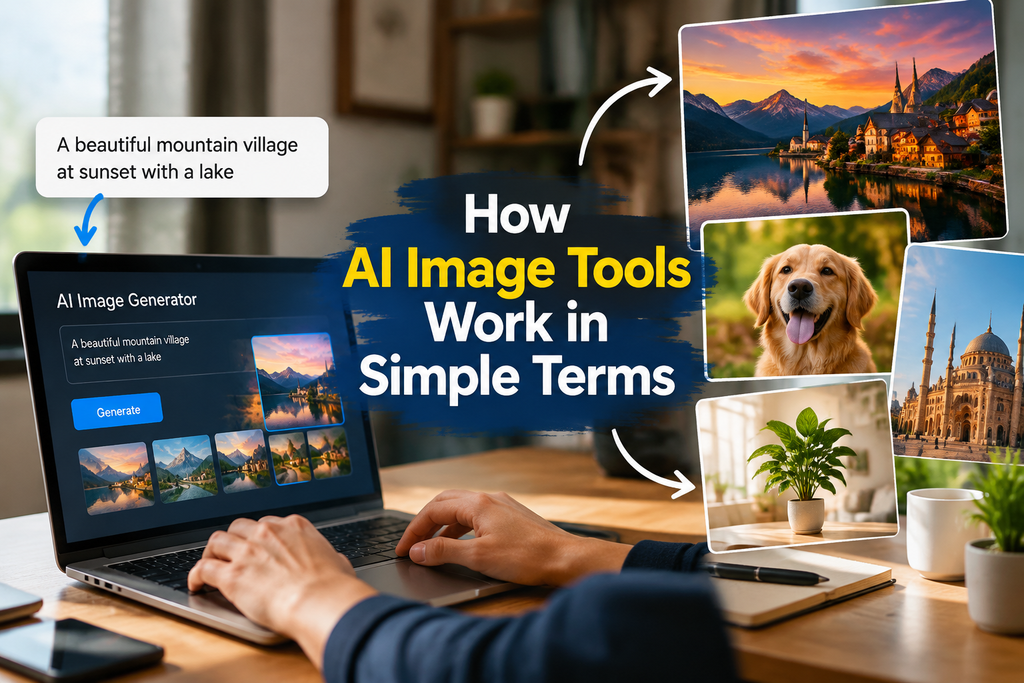
For example, a person can type “a peaceful mountain village during sunset” and an AI image generator can create an image based on that description. The user does not need drawing skills or professional design experience.
These tools can perform many tasks, including creating digital art, changing backgrounds, improving photo quality, designing logos, generating product images, and creating illustrations for websites and social media.
Popular AI image tools use technologies such as machine learning, deep learning, neural networks, and computer vision to understand images and create new ones.
How AI Learns to Create Images
The first step in creating AI images is training the artificial intelligence model. AI systems learn by studying a very large collection of images. These images may include photographs, artwork, objects, animals, landscapes, and many other types of visuals.
During training, the AI does not memorize every image. Instead, it learns patterns and relationships. For example, it learns what a human face usually looks like, how trees appear in nature, and how different colors and shapes work together.
The AI studies millions of examples and develops an understanding of visual information. This process is similar to how humans learn. A child who sees thousands of pictures of animals slowly understands the difference between a cat, dog, and horse. AI works in a similar way but uses mathematical calculations instead of human observation.
The Role of Machine Learning in AI Image Generation
Machine learning is the foundation of modern AI image tools. It allows computers to improve their performance by learning from data instead of following only fixed instructions.
Traditional software works with specific rules created by programmers. AI image tools work differently. They analyze large amounts of information and find patterns on their own.
For example, when an AI model sees thousands of pictures of cars, it learns common features such as wheels, windows, shapes, and colors. Later, when a user requests an image of a car, the AI uses its knowledge to create a new image that follows the description.
Machine learning allows AI systems to become more accurate and creative over time.
Understanding Neural Networks
Neural networks are another important part of AI image technology. They are computer systems inspired by the way the human brain works.
A neural network contains many connected layers that process information. Each layer focuses on different details of an image.
One layer may identify simple patterns like lines and colors. Another layer may recognize shapes and objects. Deeper layers can understand more complex details such as faces, buildings, or natural scenes.
Through millions of calculations, the neural network develops the ability to understand and generate visual content.
How AI Creates an Image From Text
When a user enters a text description, the AI first needs to understand the meaning of the words. This process is called language understanding.
For example, if someone writes:
“A small wooden house beside a lake surrounded by green mountains”
The AI identifies important details such as:
A house
A lake
Green mountains
A natural environment
A peaceful atmosphere
After understanding the text, the AI converts the information into a visual concept. It then creates an image that matches the description.
Many modern AI image generators use a technique called diffusion. This technology starts with random noise and slowly transforms it into a clear image.
What Is Diffusion Technology?
Diffusion models are one of the biggest advancements in AI image generation. They work by learning how images are created from noise.
During training, the AI takes real images and gradually adds noise until the image becomes unclear. Then the model learns how to reverse this process and remove the noise to recover the original image.
When creating a new picture, the AI starts with random noise and slowly removes it while following the user’s instructions. Step by step, the image becomes more detailed and realistic.
This process allows AI to create highly detailed images from simple text descriptions.
Why AI Images Look Realistic
Many people are surprised by how realistic AI generated images can appear. This happens because AI models have learned millions of visual details.
The system understands:
Human facial features
Lighting effects
Shadows
Colors
Textures
Objects and environments
For example, when creating a picture of a person, AI understands common patterns of eyes, hair, skin, clothing, and body structure. It combines these details to produce a new image.
However, AI does not truly understand the world like humans do. It predicts what an image should look like based on patterns it has learned.
The Importance of Prompts in AI Image Creation
A prompt is the instruction given to an AI image tool. The quality of the prompt can greatly affect the final result.
A simple prompt like “a dog in a park” may create a basic image. A detailed prompt like “a golden retriever running through a green park during morning sunlight with realistic photography style” gives the AI more information.
Good prompts usually include details about:
The subject
The environment
The style
The colors
The lighting
The camera view
Learning how to write effective prompts helps users create better AI generated images.
Common Uses of AI Image Tools
AI image tools are being used in many industries today.
Marketing and Advertising
Businesses use AI images to create advertisements, product pictures, and social media content. These tools help companies save time and reduce design costs.
Education
Teachers and students use AI generated images to create visual learning materials. Complex topics become easier to understand when supported by illustrations.
Website and Content Creation
Bloggers and website owners use AI images for articles, thumbnails, and online content. Unique visuals can improve user experience and engagement.
Design and Creativity
Artists and designers use AI tools for inspiration, concept development, and creative experiments.
Personal Projects
People use AI image generators for invitations, posters, wallpapers, and personal artwork.
Benefits of AI Image Tools
AI image tools provide several advantages for users.
The biggest benefit is speed. Creating a professional image can take minutes instead of hours.
Another advantage is accessibility. People without professional design skills can create high quality visuals.
AI tools also encourage creativity. Users can test different ideas and explore designs that may be difficult to create manually.
For businesses, AI image tools can reduce expenses related to graphic design and marketing materials.
Limitations of AI Image Tools
Although AI image tools are powerful, they are not perfect.
Sometimes AI creates incorrect details. For example, generated images may contain unusual hands, unrealistic objects, or small mistakes.
AI also depends on the quality of its training data. If the data contains problems, the generated results may also have limitations.
Another concern is copyright and ethical use. Users should understand the rules of the specific AI tool they are using and avoid creating content that violates the rights of others.
The Future of AI Image Technology
AI image technology is continuing to improve rapidly. Future AI tools are expected to create even more realistic images and provide better control over designs.
AI may become more connected with video creation, virtual reality, gaming, education, and professional design systems.
In the future, people may use AI as a creative assistant that helps them turn ideas into visual experiences faster than ever before.
However, human creativity will remain important. AI can generate images, but human imagination, emotions, and storytelling give images meaning.
Conclusion
AI image tools work by combining machine learning, neural networks, and advanced image generation techniques. They learn from millions of examples, understand user instructions, and create new images based on learned patterns.
These tools have made image creation easier for everyone, from professional designers to beginners. They save time, support creativity, and open new possibilities in many fields.
Understanding how AI image tools work helps users use them responsibly and effectively. As technology continues to develop, AI generated images will become an even bigger part of digital creativity and communication.

How Cloud Software Has Changed the Way People Work

Understanding No Code and Low Code Software Platforms: A Simple Guide to Modern App Development

How Modern Computer Processors Handle Multiple Tasks
About The Author
